|
JAMES SPADER on 'SHORTS'
Contributed by Michael J. Lee, Executive Editor for RadioFree.com
August 8, 2009
In the fantastical family flick Shorts, a magical rainbow-colored rock with the power to grant wishes unlocks a series of adventures for a group of kids, and mayhem for the adults around them. Told as an out-of-sequence recollection of vignettes, the movie's format is aptly described by director Robert Rodriguez as "Pulp Fiction for kids." The filmmaker, whose family-friendly fare includes the Spy Kids franchise and The Adventures of Sharkboy and Lavagirl, penned the script after being inspired by an idea from his then-six-year-old son Rebel, as well as his own recurring childhood daydreams. Rodriguez continues his tradition of working with familiar faces out of his Austin-based production studios, and takes on a dizzying array of responsibilities, serving as the film's writer, director, producer, cinematographer, editor, visual effects supervisor, and composer.
In this interview, James Spader talks about entering Rodriguez's world to work on this project, even as he was in the midst of wrapping up his Emmy-winning stint as Alan Shore on TV's long-running Boston Legal.
MEDIA: How was it switching gears from Boston Legal's Alan Shore to...
JAMES: ...to the demented Carbon Black?
Exactly.
It just couldn't be more dichotomous, really. I mean, it was just such a different world. It was just an entirely different world. After doing five years of Boston Legal and the last year of The Practice--so six years of playing Alan Shore--and working in that environment and how that work was, it has turned out to be just the most perfect thing to go from that to doing this kids' film. And then in the fall, going to New York, I'm going to do this new David Mamet play on Broadway...And not only the content and obviously the sensibility of the projects, but also just how the sort of pragmatic work day is just so vastly different. I mean, it was great fun to go down to Austin and do this picture right in the throes of coming off of Boston Legal. It was really great fun.
Robert Rodriguez has set up a pretty amazing Austin-based studio outside of the traditional Hollywood machine. What was your impression of his system?
What's amazing to me is to see Robert's activity level down there. I mean, I don't think he sleeps, really. And I don't mean that to be funny at all. I think he's one of those people who probably requires very little sleep, because his hands are in every single frame of the picture, and every aspect of what goes into each of the frames. He is cutting the picture in his head as he's shooting it. He's written the script, and therefore the edited version of what has jumped out of his own imagination is already starting to take shape. But then when he's on the set, it is absolutely taking shape on the set. He's got three monitors set up, he's working in high definition, he's working in video so he's able to fast forward and rewind on all three monitors at the same time, and we'll shoot something and they'll be rolling continuously. And we'll stop shooting the scene and we'll go back behind the monitors, and he'll show me the cut version of what he's just shot--he's going to show me exactly what it is between the three monitors: "It's going to cut from here and then to that, and then to this, and then back to this." And I can look at the scene right there. He knows exactly when to walk away. I mean, it is efficiency. It's amazing how he's been able to take these things that are so often treated as sort of toys and novelties in our lives, and they absolutely serve every single solitary part of the filmmaking for him.
[jokes] So it sounds like you'll never want to work with him again...
[laughs] I mean, he's already scanned me from head to toe, so I think it's done--I think I'm in the James Spader file down there now, and he can now take that and do whatever he cares to with it, I suppose. [laughs]
 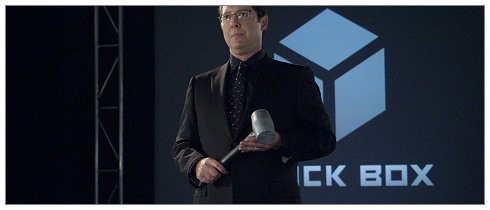
What was the on-set environment like?
There's a great sense of family down there. There are a lot of kids running around, and you're never quite sure whether they're the kids that are in the movie or the kids that are just hanging out on the set that day. [laughs] There's a scene in the conference room of sorts where I fire these two people, and the young woman that I fire is one of his sisters. The Rodriguez name is all over the credits on the pictures--on all of them, dating all the way back to when he was making little short films when he was young. When he was growing up, he was making little short pictures, and he was making them with his brothers and sisters and cousins and so on, and he's continued to do that. He now makes them with his own kids, and still his brothers and sisters and cousins, and they work in every aspect of the film. There's always a brother-in-law or an ex-brother-in-law or a sister-in-law or an ex-sister-in-law roaming around. They're all part of it. And then Robert is writing the picture and producing the picture and directing the picture and composing the music, and editing, and [being the] cameraman. I mean, he's really involved in every aspect of it. It is a fantastically unique operation down there. And it's incredibly exciting to go and just sort of be part of it for a little bit. And what it allows is that he has able to take--you know, when he talks about what it was like making El Mariachi for $7,000--every single aspect of making a film with nothing [and apply that] to the latest film--to whatever the latest project is, he's taken what he's learned from that and he's utilized it all the way through. You know, I read the script, I thought, "Well, I can't do this picture, I'm just finishing up doing Boston Legal. I still have more time on that, and it's going to take a month or a month and a half to shoot this role." Because you know, [Carbon Black is] throughout the picture. And they called up and they said, "Five days, probably? Five, maybe six? We might be able to get you out on the sixth day. If you shoot in the morning, then we can get you out." And I was like, "That's not possible. That's just not possible."
And were they able to stick to that schedule?
I said, "Okay, so let's see." And I went down there, and they did it!
Is there any downside to having a single person, like Robert, controlling virtually every aspect of a production like this?
I think it would depend on the sort of film that you were making. He's making his films, and he's making films that serve his imagination, and he's putting that on the screen. And he asks of the people that work on his films that they give themselves up to that story, which is jumping from his own imagination. If you want to do that, then fantastic. But films, in a weird way, are a selfish medium--you know, they really are a director's medium. And there are some films where where it absolutely requires a real collaboration--where it really requires it because of content or because of the nature of, or the emotion of, the piece. But these films actually require Robert's kind of involvement. I mean, they really do. If you were to read this, see this story just on the page, you'd have to say, "Well, I hope there's somebody there that knows exactly what the hell this is going to look like, because it's chaos." I mean, it really is chaos. And therefore, this has to belong to somebody. They've got to own it entirely, because I'm not going to be able to. So I showed up there and I said, "Robert, whatever you need and whatever you want me to do..." And he takes advantage of that. "Flail your arms more. Jump up in the air and scream louder." Whatever it is, whatever that is, then that's fine. It requires an enormous amount of trust.
What kind of kid were you? Were you like one of the characters in the film?
I wasn't in this film...I was never bullied. I was very small, but had very good leadership skills. But very often was leading down...Maybe not the wrong path, but maybe not the "rightest of paths." I had a lot of friends, but also was solitary a lot. I loved to play, was not very good in school. Was probably an annoyance. [reconsiders his answer] Not "probably." I was an annoyance.
Coming into this project, did you want to give Carbon Black a specifc kind of complexity, or did you just revel in his straightforward villainy?
I think both. I mean, if there was a moment where I was getting too clever, then I certainly trusted the fact that Robert was going to tell me if I was complicating things. [laughs] And I said that to him right up front, "I want to know what you want from him to best serve what you've got going on." And we talked a little bit about that prior to going down there. And I think films that have that sort of sensibility are not unlike...And I hesitate to mention this because I don't really mean to relate the two, [but] just in this one area, I think this film or films of this sort of sensibility are not unlike a Preston Sturges picture. There are no bad guys. It's a comedy. And it is never supposed to have that sort of heaviness, or too much lightness, either. You know what I mean? And I thought that was important with that character--that the things he's doing wrong are because he's oblivious to it.
And not because he's a megalomaniac?
Yeah. There's nothing Machiavellian. Everybody in the picture is caught up in the story of the picture. And he is, too. And he's completely caught up in it, and probably maybe even most of all. [laughs] And he's also not grown up, and not learned any of the lessons that he's supposed to have learned. [laughs] Everybody in the picture, if you notice, is a kid--every single one of them, including all of the adults in it. That's the fun of it. And Carbon Black is absolutely as immature as anybody, and it's the kids that are, in the end, going to teach whatever lessons are out there.
|





