|
ROBERT RODRIGUEZ on 'SHORTS'
Contributed by Michael J. Lee, Executive Editor for RadioFree.com
August 8, 2009
In the fantastical family flick Shorts, a magical rainbow-colored rock with the power to grant wishes unlocks a series of adventures for a group of kids, and mayhem for the adults around them. Told as an out-of-sequence recollection of vignettes, the movie's format is aptly described by director Robert Rodriguez as "Pulp Fiction for kids." The filmmaker, whose family-friendly fare includes the Spy Kids franchise and The Adventures of Sharkboy and Lavagirl, penned the script after being inspired by an idea from his then-six-year-old son Rebel, as well as his own recurring childhood daydreams. Rodriguez continues his tradition of working with familiar faces out of his Austin-based production studios, and takes on a dizzying array of responsibilities, serving as the film's writer, director, producer, cinematographer, editor, visual effects supervisor, and composer.
In this interview, Robert Rodriguez talks about the making of Shorts.
MEDIA: What is the significance of the title "Shorts" for you?
ROBERT: I started making short films from the age of 12 on. I always loved that short subject format. And I remember when Quentin [Tarantino] asked me to do [one of the segments in] Four Rooms, it's like, "That's what I do best! I love doing short films!" And that's where I got the idea to do Spy Kids. So I've always loved doing short films, and always wished I could do more, but there's just never a place to do them. So when my third son came to me after Sharkboy and said, "I want to come up with the next movie," I said, "Come up with something, then! I'm out of ideas right now." And he said, "Something like the Little Rascals." Which I had been showing them over a few months before to show them how funny they were. And they loved how short they were. And I went, "Of course, how come I never thought of that?" I just loved short films. And we needed to come up with a name kind of like that--"Our Gang" or "Little Rascals." And we decided to call it Shorts because [as] my son explained, the stories are short, the kids are short, and they wear shorts. And we figured it would happen during the summer, so, "Okay, that's good enough. That'll be our title for now, till we come up with a better one." Which we never did. So that's the format that the story's told in--in a series of shorts, he tells them out of order, so it's kind of like Pulp Fiction for kids, and you have to figure out that little puzzle. And I just thought it'd be kind of a unique way of telling the story for a family film, where the kids get kind of a puzzle to solve as well.
You have a history of working very well with kids. Do you direct child actors differently than adult actors?
Well, I actually direct every actor differently. So once you figure out how to direct an actor, usually you want to have them back on another movie so that you can take advantage of what you've learned and take it even further. So that's why I tend to work with the same people again and again. Because you're just starting to build a good working relationship, and off they are, gone! Especially as fast as I shoot. You're like, "We're just barely scratching the surface of your talents. Maybe we should bring you back."
What attracted you to James Spader for the role of lead antagonist Carbon Black?
[I was] always a fan of James Spader. He's just awesome. One of my favorite movies of his was Wolf. Gosh, he's so slimy in that movie...He's just good. He's just a great actor. I mean, he's the sweetest guy, but he's just good, you know? When you've got somebody that's just a great actor, they can make you think they're really slimy, and they're not.
William H. Macy, Leslie Mann, and Jon Cryer are also amongst the adult cast members. How did you manage to get them onboard for a kid-centric project like this?
Just because they have kids, too. They've done a lot of movies that their kids can't see. So when you call, I usually call those people who I've wanted to work with and have kids. And it's like, they're going to want to do something their kids can finally see.
How did you come up with the theme song for the mischievous Helvetica Black? It's pretty great.
Thanks! If you listen close, if you watch it again, that theme is throughout the whole time, but you only hear it with voices at the end, when she's on the bike. But every time you see her, it's like [sings the theme song]. I was singing that into my phone from the set, because I had already thought of the song. I went, "Oh my God, she's got to have this operatic, demonic, Omen-type song like Queen would be singing!" And I'd find it in my answering machine when I would get home. "Oh that's right, I left a message for myself!"
 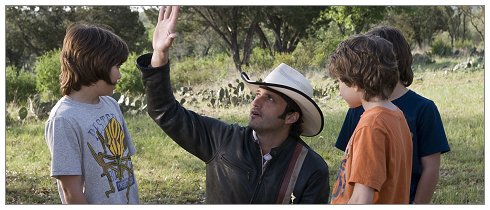
Not many directors can get away with creating a movie based on an idea their kids came up with. How do you get away with it?
[laughs] You know, it's just giving credit where credit is due. And just about any filmmaker or writer, they don't really originate all their ideas. Sometimes they'll hear a piece of a conversation or somebody will tell them something, and you eavesdrop, and you get ideas for characters that way, and stories that way. So very few things just come sprouting out of your brain. It's really you responding to the world. And my world, a lot, is my children. So when people give you advice to go write a script or a novel and they say "write what you know," what I know is my family life very well. So to not utilize that is to rob my career of a lot of inspiration and a lot of information. So a lot of times, I'll turn to them for ideas of empowerment that I've forgotten about, because you don't need it once you grow up--you're empowered, you know you can make anything happen. But for a kid who still needs his mom to drop him off at the mall or take him to the movies, he would love to have a wishing rock that he could just wish he was there and be there, or a jet pack if he was a Spy Kid and fly there, or if he could be powerful like a half-boy/half-shark. Those things really get into their dreams. So anything that empowers a kid usually does pretty well. And they watch it over and over again for those reasons. And you forget that, and you're like, "Oh yeah, I would not have come up with that idea because I wouldn't need that personally." But I see how that would trigger their imagination. And then you feed from that, and then you start coming up with the ideas that surround that.
Do your other kids come up with ideas for movies? How do you sort through all of it?
It's not like you think. We're not like at dinner and they say, "How about a movie about a creature...?" "Nope, that's not good enough!" "What about a big giant balloon that...?" "Nope!" They're never pitching anything. It was just that particular experience. And just both those times, they just happened to have an idea that they couldn't get out of their head, and they kept saying it over and over, and then I'm the one who kind of proposed [the idea for a movie]. [Rebel] loves rocks. He's always collecting rocks, and he kept saying, "Rainbow rock, and a canyon with crocodiles and snakes." We have a canyon at our property with a bunch of snakes. The one we shot in, actually, is at my ranch. So I thought, "What if that was a wishing rock?" So I tried the idea on them, and I asked Rebel, "What would you wish for if you could wish for anything?" He said, "I'd wish for a butt for a head." I said, "Are you sure?" He said, "Yep!" And so I said, "Well, let me ask his older, wiser brother." And he wished to be a potato. So I thought, "What's wrong with these guys?" So I said, "What I would wish for is a million more wishes." And then their faces sort of dropped, like, "We just blew our wish!" And then they kind of got it. So I thought, "Oh my God, this would be such a great story. Kids wouldn't know what to wish for." They would just screw everything up. So I thought that you could have a lot of fun with that. So that's how it got triggered. And then over a course of a couple years, we just kept coming up with ideas. And then I started thinking about old dreams that I had. And I remember when I was a kid, I would be by my window--I remember which window it was, on the second floor of my house--and I would put myself to sleep looking out the window dreaming, really thinking it would happen, that these aliens would come down from the sky and give me a huge watch that could make me do anything--I could become invisible, I could do magic, I could do anything, and I could go to school and do all this cool stuff, show all the kids. And they never showed up, but I had that recurring fantasy just laying there waiting for them to show up. So I got to put that in the movie, basically.
You've been able to create your own self-contained production facility in Austin, virtually independent of the Hollywood system. How do you think you've managed that?
A lot of things are just these sort of happy accidents. You know, we just kind of needed a space down there, so we rented an old airport hangar, because the airport happened to move in Austin, so the old hangars were just sitting there and they were going to just mow them down because they were just eyesores, and they weren't going to develop that area for 20 years. And we convinced them to let it stay because we could put sets in it, and we used it on Spy Kids 1 and Spy Kids 2 and Spy Kids 3 and Sin City, and slowly started adding sound-proofing and air conditioning, and putting our props up on the wall and our posters until, I think around Sin City, I'm walking to the set from my office to the set going, "Wait a minute, I've got my own studios! When did that happen?" [laughs] It was just a gradual thing. And then actors loved coming to Austin. And now with the recession, we got studios bringing me projects saying, "You don't have to even direct it. Can you just oversee it and put it through your studio with all your people? Because you just seem to know how to make movies for less, and still get something that looks like a bigger movie at the other end. We don't know how to do that." [laughs] So they gave us that. And, you know, it's a good business model. You are creating a good value without the cost, and using a lot of creativity and people who know how to make it in that style that I've just developed since El Mariachi.
You've always been able to multitask so many jobs at once--writer, director, producer, editor, cinematographer, composer. How do you maintain such a high energy level?
It's actually a strange thing. It's actually the more you do, the easier it is, you know? My mom used to say that. She would always tap me to do things, even though there was ten of us. She said that was something she had learned before. "If you want something done, give it to a busy man." And it's like, "Oh, that makes sense!" Because there's an efficiency to it. So I think if I just did one job, I think I would be more tired, and the decisions wouldn't be right because you think about it too much. So you can go more based on instinct, which is always smarter than your conscious self anyway. [laughs] And you just have to make all the decisions, so it just moves so much faster. So if I have to shoot Spader around the sun, I can get two shots or one shot and I'm done. [jokes] Because I know the editor--we're close. I know that's all he needs. I'm not going to go shoot extra angles just in case, not knowing what the editor might need, or what the producer might say because the producer might not be happy with it. And the writer, who knows what he wants, you know? "Maybe that's not what he wanted, so let's cover that, too." So by being all those people, you just saved yourself a lot of time. So I think you get a lot done. And it seems like you aren't sleeping, but actually, you can sleep like a baby because you know it all got taken care of--it's all in your head. And everyone else just needs marching orders. They just need to know where to put the lights, where to do this, where to do that.
Thanks for your time.
Thanks.
|





