
|


|
|
ANNE FLETCHER on 'STEP UP'
Contributed by Michael J. Lee, Executive Editor
for Radio Free Entertainment
August 7, 2006
In the tradition of inspirational, follow-your-dreams dance movies, Step Up tells the story of a troubled youth from the wrong side of the tracks (Channing Tatum) and a classically trained dancer striving to fulfill her lifelong goal (Jenna Dewan), and how they form an unlikely but explosive partnership in the arts.
Step Up marks the directorial debut for Anne Fletcher, who has an extensive background as a dancer and dance choreographer. Her impressive list of credits includes The 40-Year-Old Virgin, Bring It On, and Buffy the Vampire Slayer. In this interview, the charismatic and energetic woman affectionately nicknamed "Mama" talks about heading up a feature film so tailored to her talents.
|
The Interview
|
MEDIA: How was your transition from choreographing to directing a feature film?
ANNE: [jokes] Of course, I'm the bossiest person in the world. "I hate that! Fix it!" Going from choreography to directing was interesting and kind of the same as choreography, because I've been working in film so long at choreography that you always choreograph for the camera. You're trying to think of what the director wants to see, so you're already out there trying to figure out angles and stuff like that, which would be really good for the camera...So I know about character and I would always, as a choreographer, approach every job getting into the mind of the character. "Why are these people dancing? What is their purpose?" So I basically was already doing that without even knowing it, kind of. The whole directing thing was that and so much more.
As a dancer yourself, were you particularly strict about the dance sequences in the film?
I was very, very picky about choreography steps. I hate dancing for no reason. I can't watch it. It bores me to tears. I don't care how technically amazing you are or what your tricks are, if there is no reason for you to be dancing, I'm completely bored. So that was one of the reasons I'm in film, because it's always about furthering the story or furthering the character or giving it some purpose for them to be dancing, whether it's a big production number or small. I love film and that's why I'm here.
We heard the script went through a lot of changes...
You've talked to Channing and Jenna. I know you did! The story itself did not change while we were in production. I mean, it did have a lot of rewrites and story points that we really wanted to nail. But what we did do everyday practically is rewrite the dialogue because Channing, Jenna, myself...We knew what the characters were just in our rehearsals and the development of the characters and stuff like that. But we didn't have a writer on set so we had to sit down, and I'd like to say they'd open their mouths and it would be like nails on a chalk board. "God, Tyler would never say those words! Let's figure out how he would say this exact same sentence, but how does it sound more like Tyler and real?" And that was the thing I struggled from beginning to end. These dance movies can sometimes lean and fall very quickly into the world of the very cheesy and have things that are unrealistic. It's a simple story and I wanted it to be set in reality where these are real kids who have real voices who talk like every other kid in the world. We just tweaked their dialogue to make it sound as normal as possible.
We kept waiting for the line where a character says, "You've got to step up!"
No! When we were shooting the movie, we did not have the name of the movie. We were "Untitled Music High Project" forever. People started getting familiar with "Music High." I was like, "Please, no, because it's not about music high. It's not about that." "Step Up" came around. You know, we have that beautiful Wyclef Jean song called "Step Up" that's on the soundtrack, so we're like, "Why not? It has a double meaning. It's simple. It wraps it up." But when we did our reshoots, we had the name "Step Up," and I'd be talking to Channing. "So you just want to say something like, 'I want to step up now and...' No, don't say that!" It's my own personal thing when I would go see a movie that had the name of it come out of the character's mouth makes me cringe. I will be done with the movie as soon as I hear that. So if I heard "Step Up" come out, I'd be like, "No!" I think even during the reshoots, Channing had said it because I had said it...And then you've got it in your brain. I was very conscious of that.
Where did you find the funny little girl in the ballerina scene?
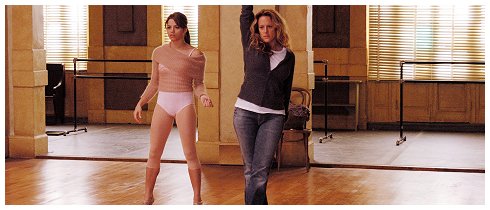
We have that little scene, which I love. Two little scenes. Friends would come in and say, "I have a daughter." And I'm like, "Bring them in. Do they know ballet? They don't even have to be great." So my 2nd AD Jack had two girls. The girl that is right in front of her and the girl that shushes [Channing] are sisters, and those are his kids. They all came in at the same height. She comes in, this little body. I'm like, "She's it. There's no question." I didn't even look at any other girls, because she's just this pint size little [darling]. So we literally had Jack on one side, I'm on the other side trying to give her direction. She's a five-year old little girl...I sent this beautiful picture, this still photographer, I took of her. Sent it home and I said, "Oh, by the way, Natalie is in the trailer." So he tells Natalie the story and she says, "Does that mean I'm going to get more money?" How does she know these things? She's a dream. She was a dream come true.
|
|
You worked on Buffy the Vampire Slayer. Do you do fight choreography as well, or did you just work on their musical episode?
It was the musical episode and a lot of the fighting stuff. I don't specifically work in fighting, but I did Catwoman. I created all of the physicality and the language for Catwoman, and would have to work with the fighting stuff. I love it. Whenever I get to work with a stunt coordinator in fight sequences, I love it. And they love it. I've worked with a lot of stunt people who love working with the dancers because we come from the same mentality. It's the same creativity that you have to make it interesting. You know, a fight is a fight. If you got into a fight it would look like the opening fight in Step Up. Raw. Just punches throwing for no reason. No specific hitting. But I don't specifically work as a stunt choreographer, but I have worked with them and loved it and would continue to do it.
What kind of challenges do you face when you do dance choreography for something like Buffy, where the cast is already in place and they haven't necessarily been hired for their dancing skills?
They're not so difficult because a lot of times they will already know that we're coming in there, so they're a little bit more mentally prepared for what's in front of them. Sometimes it's tricky because an actor knows what they're doing. They're completely in control of what they're doing. Same thing with stunts. They know on two I've got to hit, on three I've got to duck. They know the structure. With dancing, it's such a vulnerable place because not very many people can dance and they're incredibly vulnerable and shut down and they get a little snippety. Generally speaking, it's my job to get in there and disarm them and make them comfortable within seconds, [so] that I can get them up and dancing. Especially in television, everything is so fast. You don't get time to sit and figure out how they work. You've just got to be able to work really, really quickly and get in their brains. I think it's a psychological test and I think I'm pretty good at it, because I've been doing it a long time. But it's a psychological game. You've got to be on your deal and you've got to make them trust you the second you walk in the door. That's really the trickiest part. And then hopefully, they're in with you in five minutes and ready to go. The one thing that I say to everybody is, "I'm not here to make you look bad. I'm not here to make you look foolish. I'm here to make you look good. If you can't do A, B, and C, I'm going to turn it into D, E, and F. I'm going to make it work for your body." So then they go, "Okay, I get it." So that's usually my ticket.
When you were a young dancer growing up, did you face any sort of showcase pressure like Jenna's character in Step Up?
I did a lot of recitals growing up. We didn't have showcases because I didn't go to a performing arts school. But we had recitals every year. My mom brought me to dance competition things. But not a lot of them. Those were hardcore. I remember one specifically, and I danced my butt off and I kicked butt. I was like, "I've got this in the bag." A girl who tap danced to "Queen of Hearts" won, and I was so angry. To this day, the fact that it's even still in my memory, because I have the worst memory...I was like, "How is that possible?"
How old were you?
16 or 17. Around there...So yeah, that's impressionable in my brain. There were these conventions that would come to town all the time that we would dance in and they would give scholarships away...I danced my butt off. I mean, dancing was everything. I am [Jenna's character] times 50. I was a competitor. I played sports almost my whole life. Got into dance, so competition was something that was very in my blood. I had to be the best and number one when I danced or played sports or did anything.
While casting, were you looking for actors who could dance, or dancers who showed potential to act?
Both, because I didn't want to double anybody with their dance, and I didn't want to double anybody with the singing. I wanted everybody to do their own everything. I thought it was really important to the story and really important to the movie, staying in reality. So I knew that there were people out there who sang and acted and danced. I just knew that these people existed, and lo and behold, that's what I got. I did have a couple dancers come in that I knew and worked with through the years, and acting in their studies and stuff like that, they hadn't gotten to the level that they could star in a movie. We went through all the casting. We went through all of the agencies, through the proper channels that you would normally go through. We found Channing right away. Jenna was a little later down the road, and Drew Sidora...Well, Mario was number one. He was the first person that came in and the door shut behind him, and we're like, "Hire that boy right now!" He was so good. Drew submitted herself on tape from Chicago where she's standing in front of her fireplace singing her little song that she released on the air in Chicago. Then she did a scene for us and I'm like, "Oh, we found Lucy." I mean, like the 11th hour. We were getting ready to hire somebody nobody was really in love with, but she would be great. It just wasn't there. As soon as we saw Drew, we're like, "She's it."
|
|
|





