
|


|
|
DAVID VON ANCKEN on 'SERAPHIM FALLS'
Contributed by Michael J. Lee, Executive Editor
for Radio Free Entertainment
January 19, 2007
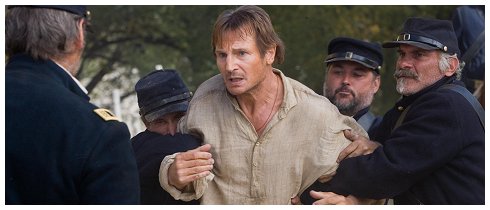
Using the American Civil War as its backdrop, Seraphim Falls follows a former captain in the Union army (Pierce Brosnan) as he is ruthlessly pursued by an ex-Confederate colonel (Liam Neeson) seeking vengeance over wrongs committed during the war. This quiet, wonderfully told tale has a timeless message on the tragedy of war without ever being heavy-handed, and focuses most profoundly on themes of forgiveness and redemption. But most impressively, it features a pair of strong lead performances in a subtle, unique setting: while this pursuit story has been largely categorized as a Western, it also infuses a surreal vibe at points, giving it an intriguing look and feel that transcends the genre's typical conventions. It manages to be both understated and filled with action, and it is abundantly suspenseful.
Writer/director David Von Ancken, who has helmed numerous episodes for TV shows, including Oz, The Shield, Cold Case, and CSI:NY, makes an impressive feature film debut with Seraphim Falls. In this interview, he talks about the making of the movie.
|
The Interview
|
MEDIA: Why did you choose the Civil War as the backdrop for this film?
DAVID: Well, I think when I set out to write it, I had a very simple chase story in mind--a very simple allegory about one man chasing another. The Civil War didn't really become the setting, or the Western didn't really become the setting, until after I'd thought of just how to tell a quiet story without the white noise of what's going on now. Even in the West, how to stay away from towns with the most civilization [was critical], so it was sort of the natural answer to getting away from society and letting the story be told in very quiet, simple terms by these complex actors with complex characters.
So did you have current issues of war in mind while you were writing the script?
Yes, absolutely. I mean, it started as a parable about violence begetting violence, which was two and a half years ago when we were just getting into this war. It's clearly an anti-war movie, yet in the construction of the actual movie, I wasn't going to beat the audience over the head with it. So taking dialogue away from the guys and letting them tell it behaviorally lets you sort of steep in the themes a little bit slower so you can draw your own conclusions. But clearly it's about the Civil War, which is our most devastating example in this country of what war can do. And unfortunately, we're seeing that now. And how it's almost inevitable that people who go through a war, both citizens and soldiers, aren't better for it.
What would you like an audience to take from this film?
Whatever they want. I mean, I'm just really not going to give it. I think it's a quiet movie. It's a simple story, like I said, so it's open to interpretation. I have my own, but really, the best part is letting other people determine their own.
Are you particularly fond of the Western genre?
You know, I grew up watching Westerns in upstate New York at drive-ins. This was influenced, I think, maybe thematically by the Westerns of the late Sergio Leone/early Clint Eastwood, from High Plains Drifter to Outlaw Josey Wales, maybe some of those Pollack movies like Jeremiah Johnson. Those are movies where your primary actors say very little, yet to me, they emote a lot.
Do you feel the violence works as an effective metaphor?
The violence to me (if it works, especially in a Western, you're so burdened with the genre) has to be necessary for survival. And there's a very simple, direct, linear story. As you get into the Salt Flats, it may get a little more surreal, but what these guys each need both emotionally and physically is very simple, and that is best told by a Western. The violence can be visceral, it can be very surprising. It is necessary for them to get to the next step.
What was your inspiration for the film's visual style?
It's all in camera. There's no CG in the movie. You know, you could shoot a waterfall sequence where you have a guy going over a waterfall at Warner Brothers in a room, but we threw a guy attached to a helicopter over the waterfall and we filmed that. To me, there's just a slight textual difference still, so you feel Pierce coming up out of that waterfall. He's tied to several tethers, but that's Pierce coming up from underneath the waterfall himself. You know, it's not a stunt guy with a face replacement. So I feel that there's still room to do these old in-camera movies. It was kind of an experiment to see if we could get people together. We had John Toll, who is the cinematographer, who is a very, very talented available light DP. You know, we didn't light this movie. We were outside for 46 of 47 days with no cover, so if it's turned to rain, we have to turn around and shoot something else. Or I would go back at night and rewrite the script to sort of make sense for the thing we just shot, because you were very much at the whim of mother nature. And she came at us fairly hard. We lucked out overall, but there were days when the snow would be snowing, and five minutes later, it would be missing, and then 20 minutes later, it would be back. So how do you make that work?
And where did you film the movie?
We filmed it about 90% in New Mexico, Taos, Santa Fe, Boardsburg down in the desert. And then for the river, since there aren't any rivers in New Mexico, even though the Rio Grande is wide as this table, we went to Oregon to the McKenzie River in January and hit these record levels of flooding. That was rather fun.
|
|
Did you write with any particular actors in mind for the roles? How did you end up with Pierce Brosnan and Liam Neeson in the leads?
I never write with anybody in mind because I think it kind of restrains you a little bit from the possibilities, and you always want to come to an actor and say, "Surprise me." But specifically the two guys, I thought when we sat down to cast this thing, "What's your wish list?" It was very, very lucky. Coincidence, I suppose, scheduling, desire on their parts, but it took a little bit of going through that Hollywood machine for me to get each of them into these roles, and for the people who are paying for it to agree. But more or less, when I approached Liam, he said he'd been waiting for this role for 15 years. So that was sort of an instantaneous coming together. And Pierce, I think within a day of talking to him, he was in. So these guys were very agreeable to the whole thing.
What did you see in those two in particular that made you want them?
That's a good question. What I saw in both of them was their ability to come at an audience in a behavioral fashion and say nothing. To me, it was a little bit more evident in Liam's role...It seems he was of the earth. He was a real Antaeus of a man in his characters and he can say a lot without saying any words...Both of them, [it's in their] eyes, which is a cliche, but you do see that. But both of them in their bodies, when they don't speak, they can get their point across. And it was a conscious choice, when I was writing it, to see if we could make a movie in today's Hollywood where your lead characters say 50 lines in the whole movie.
How tough was that to get people to buy into?
From the actors' perspective, not at all. They loved that stuff. From the producers' and financiers' perspective, once they saw the action and saw who we were bringing to the table, it was also, I think, very agreeable. That's why it was independently financed. Icon put up all the money, and they were very supportive from the very beginning of entirely what I wrote. They didn't try to change a word. So if I wanted to change something, Bruce Davey was fine. They were terrifically supportive of a very old school style of filmmaking.
You've directed a lot of episodes of several successful TV shows. How did the those experiences compare to shooting a feature film?
Well, TV, you have 7 to 10 days to create something and you're moving at a very fast pace. You're moving through a system that exists. Our system for Seraphim Falls didn't exist. So I thought mistakenly that I'd have more time to shoot now that I had a feature--the first one I had ever done after having shot dozens of TV shows. You know, you're moving very, very fast in television to achieve an episode in that limited amount of time. The most surprising thing for me, from the perspective of production, was that I even had less time to do this on a given day. Primarily because whatever it is is what it is. We went to make an outdoor movie in the fall or winter when you have no light. So we were waking up at four in the morning and the sun was already setting on us. So we had no time to make this. You know, there are days in Oregon when we didn't achieve light until 10:30 and we were done by five after four. That's a very, very short day in terms of filmmaking.
Did you feel your television experience really prepared you for this task?
You know, I'll tell you, if I hadn't done television, this movie would have never been finished. In TV, you have to think on your feet, I think, because you're always thrown different side balls that you have to adapt to. And this was just an exponential version of that, because in TV, you have producers and you have studio people and you have a whole group think that solves problems. You know, the director is solving it on the set, but in a movie, it's like a V, and you're at the bottom as a director and a writer. Thankfully I wrote it, because I rewrote this movie as we shot everyday. Every single day there were changes that had to happen.
How did Angelica Huston get involved in that sort of mysterious cameo role?
Well, I called her up and asked her. She came a little later, obviously, than the two leads. You know, there's a very short list of people who could pull off this Madame Louise role effectively. And the list becomes even shorter if you want someone who has the sort of gravitas and timelessness of being able to show up in something not necessarily grounded in reality, maybe something grounded in hallucinogenic water deprivation. I mean, what's going on with these guys when they get out to the Salt Flats? So she was one of one or two people that I thought would be great, and when she heard it was Pierce and Liam and we showed her the script, she was in. So again, there was a kismet to the casting of this thing because very few people that were in the top one or two ever didn't say yes. So again, it was probably luck.
Have you been asked any strange questions about the nature of Madame Louise?
"Is she death?" I heard that recently. In fact, I heard that earlier today. "Is she death?" "Yeah, I guess." I mean, it goes back to your question: whatever you or the audience bring to it. Certainly, I wanted her and Wes Studi's character to be...Wes Studi I called "Charon" in the script. You may or may not notice he's sitting in a little stream, and each of the guys crosses that stream. And there's a lot of sort of stuff that you may or may not pick up on, and that's okay. But certainly on the back of her cart, if you see it on a big enough screen, you'll see it says "Madame Louise's Sefer." And so you could clue into that a little bit. But you probably won't even see it. And she's just a snake oil salesman, but she's affecting. You know, to me, you have to be complicit in your own damnation and you have to be complicit in your own salvation, and that goes back to some of these underlying war themes that I think are embedded in this story. And you cannot let these guys die after going through so much with them (at least I couldn't) without learning something. Conversely, you couldn't just let them walk away. So they have to come to that moment, that crucible, which is out in the desert where they are handed the ability to go either way. Through all this fighting and all this shit they go through, at the end of the day, they have to have that ability to make their own decision, and she facilitates that. You know, "Here's a bullet for your water. Here's a gun for your horse." And she's hoping, I think, that they shoot each other.
Thanks very much.
Thanks, guys.
|
|
|





