
|


|
|
TOBY BLUTH on 'PINOCCHIO'
Interview by Michael J. Lee, Executive Editor for RadioFree.com
March 4, 2009
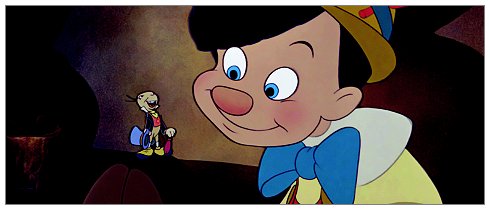
Following up the groundbreaking masterpiece Snow White and the Seven Dwarfs, 1940's Pinocchio became Disney's second entry in its pantheon of animated feature films. Now, nearly 70 years later, the classic has received a complete restoration for a striking Blu-Ray edition for a new generation of fans. One of the unique features of this version is an option to watch the movie seamlessly flanked by artistic panels on the right and left, effectively increasing the aspect ratio to a widescreen format without distorting the original film. These panels are actually paintings done by renowned artist Toby Bluth, and they effortlessly blend into Pinocchio without distraction, a remarkable feat that looks surprisingly natural.
Toby Bluth has worked as an animator, character designer, and art director throughout the decades for studios like Walt Disney, Sullivan/Bluth, and Hanna-Barbera, and his artistry has also extended to directing and performing in musical stage plays. In this exclusive interview, we had the opportunity to speak to Mr. Bluth about his new work on Pinocchio, his perspective of the film's historical impact on animation, and his involvement in two classic cartoons of the '80s, Alvin and the Chipmunks and The Smurfs.
Pinocchio is now available as a 70th Anniversary Special Edition 2-disc Blu-Ray.
|
The Interview
|
RadioFree.com: What's the secret of seamlessly integrating new artwork into a classic like Pinocchio?
TOBY: Make it look like old artwork! I didn't want it to look like it was new. I wanted it to look like, "Oh, was this done in 1937, or 1940?" I wanted it to look like it was old. So I used the medium that they used, which was basically transparent water colors, and I painted everything in the paint they used. And then I went through the film and I would find frames that they did, and I wanted my frames to have the feel, or the scenery, of that.
How do you decide on the actual content of the panels, from the wooden frames to the field of stars?
Well, you look at film and do what the film did, and don't interpolate too much. You know, it's really art. In this project, I felt I was like an accompaniment. You're not supposed to notice me. You just feel like, "Boy, this sure looks like Pinocchio." You should never really think about it...Because if someone said, "Oh, that looks so good, it jumps from the film," then I did it wrong.
Each Disney classic that has withstood the test of time was known for opening some sort of door in the field of animation. What was Pinocchio's big breakthrough?
Well, you have to go back one film before Pinocchio. You have to go back to the first one, Snow White. And the breakthrough was...Everybody said, "This is Disney's fault, no one's going to sit through a cartoon that's that long. A full length animated feature--it's not going to work. They're not going to like it." And they toned all the colors down because there was a philosophy that you could only absorb so much color so fast, and then people are going to get irritated by it. Well, [the naysayers] were wrong, and it all worked. And with Pinocchio, they thought, "Maybe we can [do this]." And they did.
How did Pinocchio push the envelope for animation in its day?
They specifically hyped the color. They hyped the drama and the reality of things. It would be more like a live action film where you could actually talk about subjects. I mean, Pinocchio sits down and they have cigars and a beer, you know? They won't do that today. But they did it then, you know? They didn't have those problems. And I don't think they realized they were pushing the envelope. I think they just thought, "Oh, we can make a film. We can do this. We can do anything we want to do." And so they did.
Does having so many restrictions on content nowadays hurt animation?
Yes! You know, don't reign it in. Any time you draw a boundary around anything, you have limited it. Let it fly, let it do what it's going to do. You don't know what it's going to do. There were no boundaries for Fantasia. There were no boundaries for Snow White, or around Pinocchio, or Dumbo. They just let it fly, and they did what the story seemed like it should do. In Dumbo, you have the baby elephant get drunk! I mean, I hate to harp on the alcohol, [jokingly gestures at his drink] but they didn't have those boundaries that we do now. [laughs] You know, they used to [break] boundaries. Now we impose them. "It's a kid's movie, parents don't want to see too much of this, or too much of that." Just make your film.
On the positive side, technology has made great advancements that can help animators do their job. Is there a new tool that you would have liked to have back in the day?
Yeah. But you know, I'm kind of a crossover...[With] computer animation, I could create a snow storm that would have taken hours and never come off as well. So there's a place for the computer, and there's a place for the human element. And I like it when it's merged, when you put the two together.
|
|
Do you have a Disney project that's particularly close to your heart? A favorite?
Oh absolutely: Snow White and the Seven Dwarfs. And I know why, too. They were virgins. They had never made love before. They had never made a feature length film before. Nobody had ever done this, nobody knew if it would work, they were scared sh*tless, and they went in there and they did it. And it's the most beautiful virgin experience in filmmaking that I know of.
You had a hand in two '80s cartoons from my childhood: Alvin and the Chipmunks and The Smurfs. What did you do on those projects?
Alvin and the Chipmunks...CBS was thinking of resurrecting them. It was an old thing way out of the '50s or before. And they wanted a special that they could try out--a half-hour special--and see if the audience was still there. So Janice and Ross Bagdasarian, who owned the rights to Alvin and the Chipmunks, because they created it, came to me and I art directed the entire film. I painted every single one of the backgrounds in the film. It's a half-hour film. I did all of that. Based on what I did, they decided to do Alvin and the Chipmunks as a Saturday morning series.
And what about The Smurfs?
Well, same thing. It was a very highly popular series of books in Europe. Hanna-Barbera had bought the rights to it, and a man came to me and said, "Show me what this should look like and do a presentation to sell to the network." So I did the presentation and the look for The Smurfs, and they sold it to the network. The disappointing part of the story is our union gets no residuals. [laughs] But I'm still laughing.
Ross and Janice seem very pleased with the live-action/CG movie of Alvin and the Chipmunks, and there's a CG Smurfs on the horizon. Do you think those two projects translate well to that medium?
No.
Not at all? What do you think it loses in the transition?
It loses the intimacy of hand-crafted [animation]. When it's drawn by a person, it has a specific kind of intimacy and look to it. When you do the CG on the computer, it starts looking like...Remember Gumby and Pokey the horse? It starts looking like claymation, you know? And I'm not a real big fan. Now, some people do [like it], and obviously CG is extremely popular, and I'm not knocking it. But it's not the one I'm enamored with. I like the intimacy of hand-drawn. You know what? You want to get a [frame from a CG movie] and hang it on your wall, frame it? Where are you going to get it? There's no such thing! You want an original cel from Snow White or Pinocchio? Well, then you go spend $40,000 for it and get one. [laughs] There's such a thing, and it's real, it was done by hand. And that's the difference to me. There's an intimacy, and an integrity.
Is there another Disney classic that you feel is ready for Blu-Ray?
I'm working on it: Snow White and the Seven Dwarfs.
Oh, your favorite!
Yeah, my favorite! Why would they ask anyone else to do that, you know? What are they, stupid? [laughs]
[laughs] Sometimes they are, actually. Will you be taking the same approach with the artwork panels?
Yeah, same approach, because it's very theatrical. It's like going to see a stage show. And I did all these musicals for years. And these are very much like that. It's like changing the scenery on the stage.
|
|
|





