
|


|
|
GREGORY SMITH on 'NEARING GRACE'
Contributed by Michael J. Lee, Executive Editor
for Radio Free Entertainment
September 20, 2006
In the drama Nearing Grace, a young Henry Nearing (Gregory Smith) must cope with the death of his mother, deal with a depressed, alcoholic father (David Morse), contend with a wash-out of a brother, and reconcile feelings for two girls in his life: his lifelong best friend Merna (Ashley Johnson) and trouble-prone seductress Grace (Jordana Brewster). Based on the novel Nearing's Grace by Scott Sommer, the film explores themes of relationships through a family that loses its direction in the wake of its matriarch's death.
In this interview, Gregory Smith (Everwood) talks about the making of the movie, from embracing the script to recreating the '70s to working with the two leading ladies.
|
The Interview
|
MEDIA: How was the experience of making an independent film like Nearing Grace different from working on a long-running television series like Everwood?
GREGORY: Very different. I mean, everything about it is really, really different, mostly in terms of just the amount of time you have to do the amount of work you have to do, and the pace. And it's just like a different set of rules. You know, you get thrown together with people on film and you don't know any of them, and you become best friends, and then you don't really see each other ever again. And on a TV show, you get thrown together with people and you're stuck with them. [laughs] But they're both great. The nice thing about doing a TV show is you do it and millions of people are going to see it on their television sets every week, and it's great and you know that there's going to be an outlet for it. With a film like this, it's a lot more of a risk, and you really want to sort of put your heart into it, because if you don't, then people aren't going to see it, people aren't going to want to see it. So there's not a built-in outlet. It's up to you to sort of create something.
Were you familiar with the novel going into the project, or was the script your first exposure to the story?
Yeah, the script was my first exposure to the story. You know, Jacob Aaron Estes wrote it, who wrote Mean Creek, who's one of the most incredible screenwriters I've ever read. And I read the script and I was so taken with it, it was almost like love at first sight. And so then I went out, and before I had my meeting, because I was like, "Okay, I gotta get this," I went and I got the book, and I put together this whole kind of like proposal...Or not proposal, but kind of like put together a whole package of information of how I saw it and I took pages from the book, and I kind of put it together into my script and kind of incorporated the two. And that's when I went in and met the director for the first time, that's sort of how I sort of tricked him into hiring me.
What attracted you so much to the script?
I was having like a really bad day--like a really crappy day. And I was at some sort of shoot somewhere, and on my lunch break, I had the script in my backpack. So on my lunch break, I like went off in the corner and I sat there and I started flipping through this script. And I finished it. I just tore right through it, which is always your first indicator. And then, as I was going back to work, I realized I was skipping, because it was like it had totally taken my mood and it had taken me, and had very similar themes that resonated with what was going on in my real life. But it gave me that experience, and put a positive spin on it, in a positive light, which I know seems weird, but it just touched something inside me. If somebody could watch the movie and it could take them back to a time or a place that had long since been forgotten and maybe smile about it, and remember the good time...That was a sort of a resolve that I wanted. That's what drew me to it. Does that make sense?
Was there a particular line or scene?
It wasn't a line. It was just an overall...Like just reading it, it just totally brought me back to a place that wasn't so far away for me. But it just totally reminded me of my life and something that I had dealt with. But for some reason, it didn't make me depressed about it. It made me sort of think about it and smile. And a lot of people I know, like friends of mine that have seen it and stuff, especially people that wouldn't expect it, the one thing that I've heard most consistently is they say it brought them back to a particular time in their lives where they were trying to figure stuff out, but it was a nice trip back. It wasn't like a depressing trip back.
Did the set have the feel of the '70s, or was it a more modern vibe?
I didn't really know that much about the '70s. I mean, that's one of the cool things about doing movies. It's always an opportunity to...You know, an excuse, basically, to go spend a lot of money at like Virgin or something. So it's like, "Okay, I'm doing a '70s movie, so..." I found out what the most popular movies were then, what people living at that time would have been watching, and then movies that have been made since about that time. And I probably brought 40 DVDs with me to location. And I don't remember what they were now, but I downloaded all the top 40 like book lists, and I got all the same sort of...You know, the books. And tons of music, and I just basically insulated myself with all things. So that was just all I exposed myself to. And so I don't know if it had a '70s vibe on the set or not, but for me, I just completely surrounded myself with that, and hopefully, through osmosis, got some of it.
Do you normally approach a role like that, by immersing yourself in the period's culture?
It's always different, but that's one of the things I like to do, is just basically...Yeah, just try to absorb things rather than cram them, do you know what I mean? Just kind of surround myself with stuff. Like I'll go and there'll be a particular way that I'll think this character would dress, the types of clothes he would wear, so I'll kind of go buy a couple things and I'll start wearing that. In the weeks leading up, I'll start writing things from his point of view and just sort of really slowly try to find exactly what the voice is, so by the time you're on set, the voice is very natural. When you're playing a character you don't like, it's a real pain in the ass. [laughs]
|
|
What was it like working with Jordana and Ashley?
They're great. They were awesome. Jordana...I mean, she's Jordana Brewster. I actually did a table read with her when I was like 14, and I don't think she remembers. But I was staring across the table the whole time, like [in awe], "Oh my God!" And they were like, "I think it's going to be Jordana Brewster." And I was like [bangs table, claps hands], "Yes!" [laughs] And then actually, Ashley and I have known each other...We've been friends for a long time before this. And so it was just awesome to go up to Portland, and working with them...I mean, it's hard to [compare them]...They're both so different, but they're both so awesome. Ashley, I think, is probably like...People often watch the movie and say she's like a revelation. Her character, and just the whole experience of working with her, is one that's yet to be matched, for me as an actor, or as a person.
Did your previous relationship with Ashley make it easier to play the relationship your characters have in the movie? Or did it make it harder?
I guess it probably made it easier, just because we both knew each other, and we both knew that we liked each other, and we wanted to help each other and work together. And so it probably made it easier. But it was less the fact that we had a relationship and more just who she was. You know what I mean? It's like, if we hadn't had a relationship, I don't think the experience would have been any different. But it didn't hurt, I don't think. You know, we hadn't seen each other for a couple years before this. But yeah, she's one of those people...I won't see her for a year, and then we'll see each other, and it's like no time has passed. You know, it's like one of those kind of good friends that you all have in your life at some point. And so I think that, yeah, like I said, if we hadn't known each other, I don't think it would have made a difference.
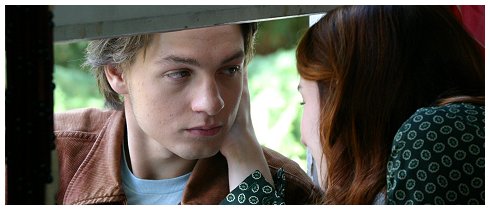
Have you ever had a "crawl through the window" kind of best friend relationship like that?
Not "crawl through the window," but certainly like sort of metaphorically, yeah. [laughs] So I had to put some bars on the windows. [laughs] No. You mean like a best friend? A Merna, kind of, for me? Yeah, absolutely.
What about a Grace?
Not yet. But I'm hoping. [laughs] But that's one of the things about the movie, as well. It's like they're almost different sides of the same coin. Most guys I know that I've talked to, or even girls...You can categorize people that you've connected with over the years, and they're either a Merna or a Grace, you know?
Who would you pick between the two?
Well, you can't appreciate one without the other. [laughs] That's my story and I'm sticking to it. [laughs]
You've done a lot drama. Any plans for maybe a comedic or action role?
Yeah. Action would be cool. You pick roles to a certain extent, but they also kind of pick you. So I would love to do everything. I have a production company and we just made a film that was just a...This broad comedy. I didn't act in it, we just put it together. So I'd like to do anything and everything. But it takes two to tango.
Were you very self-conscious during the scene in which you have to dance around in the underwear?
Oh my God. [laughs] Yeah. For the weeks leading up to that, every day at lunch, I would go up to the director and be like, "You know, I've really been thinking about this, and I don't think it's integral to Henry's arc. I don't think it's necessary for the film." And I would try to intellectualize why we didn't need to shoot it. But I was actually just scared. And he'd be like, "Greg, you're dancing in your underwear." But yeah, when we shot that, I was really, really, really nervous, because I was supposed to do a ballet in women's underwear. How can you not be nervous? And so the director, in a show of solidarity, actually...I walked onto set, and everybody's acting kind of funny, I don't really know what's going on, and I walk around the corner...The director's a big guy, and he was wearing the same pair of underwear, and sneakers. And he directed the whole scene holding this video thing like this, going, "All right, action!" And you look, and he's just like this big guy wearing the same underwear to make me feel more comfortable. What it did was terrify me even more. [laughs] That was good. No, but it actually was a really cool thing for a director to do. It made me feel more comfortable. And I think the scene...It's actually one of my favorite scenes in the film. You know, people say try to do something every day that scares you, but it really is true. Especially, I've found, when you're working on something, when you feel uncomfortable, when you feel off-balance, it's usually when stuff is the most real, and usually, in retrospect, the stuff you enjoy the most.
How was working with director Rick Rosenthal?
Awesome. This was probably the most collaborative experience that I've ever had on a film. Right away, he had brought me in and involved me in the development of the script. I've always had ideas, but I'd never really had somebody take them seriously. I mean, you know, I've been like, "I've got this, I've got this..." People are like, "Okay, that's a good little actor. Go sit in the corner." But Rick and Susan Johnson, the producer, they really, from all of us, wanted to hear our ideas, and then they really implemented them into the film, stuff from blocking to dialogue. I mean, everything. Even early on, the basic structure of the story. And it was very empowering and it was something that I took with me from this experience. It was really a positive sort of thing, and that's mostly to Rick's credit.
Thanks for your time.
Thank you.
|
|
|





