|


|
|
KIEFER SUTHERLAND on 'MONSTERS VS. ALIENS'
Contributed by Michael J. Lee, Executive Editor
for Radio Free Entertainment
March 20, 2009
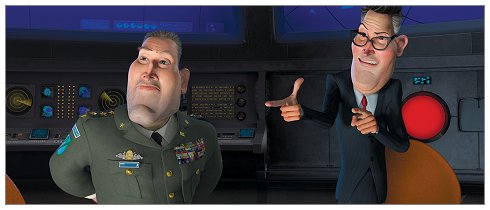
A contemporary homage to the monster and alien B-movies of cinematic yesteryear, Monsters vs. Aliens is a family-friendly animated adventure that tells the story of Susan Murphy (voice of Reese Witherspoon), a sweet and spunky bride-to-be who is transformed into a 49-foot-11-inches tall, super-powered giantess after being struck by a mysterious glowing meteorite the morning of her wedding. She is immediately wrangled by General W.R. Monger (voice of Kiefer Sutherland) and the US military and placed in a top-secret government confinement facility, where she is renamed "Ginormica." There, she is introduced to her fellow "monsters": the hungry, gelatinous mass with no brain, B.O.B. (voice of Seth Rogen); the brilliant mad scientist Dr. Cockroach, Ph.D. (voice of Hugh Laurie); the macho, trash-talking Missing Link (voice of Will Arnett); and a 350-foot bug, Insectosaurus.
But when earth is suddenly invaded by the evil alien Gallaxhar (voice of Rainn Wilson), General Monger advises the President (voice of Stephen Colbert) that the monsters could be the key to earth's salvation. A deal is quickly struck: in return for saving the world, the motley crew of Ginormica, B.O.B., Dr. Cockroach, Link, and Insectosaurus will be given their freedom. At first shy and timid and unsure of her sudden transformation, Susan eventually comes to see her unique differences as personal strengths, rallies to the challenge of being a superhero, and even stands up against her unsupportive fiance Derek (voice of Paul Rudd).
In this interview, Kiefer Sutherland talks about taking a brief departure from the rigorous demands of 24, embracing Monsters' inspiring message to children, and channeling his voice in a decidedly un-Jack Bauer way.
|
The Interview
|
MEDIA: A lot of people didn't know you had all of these voices in you...
KIEFER: [laughs] You got no idea!
Reese Witherspoon has said that nobody realizes how funny you are...
Oh, that's sweet.
This was a bit of a departure from the intense drama you're known for. Had you ever considered taking your career in a more comedic direction?
I think all of us have been funny at a dinner, which is very different than "making a movie" or "being on stage" funny. You know, the great comedians of our time have a natural gift--there's a natural gift of timing, of physical comedy and all of those things. It's not what I was drawn to when I started working as an actor. You know, I think one of the reasons why I did an animated film and could be funny was I got to leave the physicality at the door, and the animators can make that physicality kind of charming and what it is. I've always been drawn to the more dramatic dynamic of the human condition, and that's why I do what I do. But certainly in the context of this, I was making 24 at the same time when I was doing Monsters vs. Aliens. So for five days a week, 14 hours a day, I would do [24], and then for 6 hours a week, I'd get to play this character and let loose, and be 5 [years old]. That was a fantastic counterbalance to that.
General Monger could have simply been a belligerent military leader, but he eventually softens and shows some heart. How did that evolution come about?
Well, it was the writers. But it lent itself towards the general point of the film. And I've never chosen a character as an actor. I've always kind of been drawn to an entire story, and however I fit in, great. And this was no different. I loved the idea that they were making a movie that was geared towards young children, telling them that it was all right to be different. And not only was it all right to be different, but that thing that might make you feel awkward about being different could be your greatest quality. And in the context of our movie, it allows Ginormica to save the planet. So I don't think there's a more important message that you could actually send to children. And consequently, my character is the same. He has this responsibility to run this prison, but he also knows that--and he says it in his first speech--these monsters are not vicious, or dangerous and maniacal. They're just simply different. And we have to keep them away from society because society won't understand. But even when he's putting Ginormica in her cell and she starts to cry, he starts to go, because he can't handle that. He does feel bad for them. And then all of a sudden, he gets this opportunity to kind of show how special they are. And I think he's very proud of that. He's pretty excited about getting out of that prison, too.
Any childhood memories of being different and trying to fit in?
You know, I certainly remember, growing up as a kid, that terrible moment when you decide to make a fashion statement at 7, and you decide to wear your socks outside your pants, and you think it's cool, and you go to school, and it's not cool. [laughs] I remember those times. I had a backpack... [laughs] I can't believe I'm telling this. When I was growing up, Levi's had a backpack that was like a Levi's pocket. It was the most coveted thing. And my mom had no money. And so I got mine a year late. And you know what a BeDazzler is? It's like a rhinestone gun. My mother was a great product of the '60s, and somehow, when I went to bed (and I was so excited about taking this to school), my mother had bedazzled it to hell with my name in rhinestones and a peace sign and some other sh*t. And I had to bury that backpack on my way to school every day for like two years, until I finally told her someone stole it. So this desire to fit in is just unrelenting for children. And being able to tell them, "You're all right. Whatever anybody else says, just you as you are, you're all right"...I love that idea. And so again, I can't tell you how much that resonated with me.
|
|
Monger says several odd, random things. Was there a bigger backstory for him that wasn't revealed in the movie?
No, I threw those in hoping there would be a sequel. [laughs] No, I think one of the things in [the writers'] perception of a general [is that] these guys are just so eccentric, and they probably shouldn't be doing what they're doing. And so he just mumbles and he talks--I mean, he talks to himself, I think, constantly. Half the sentences are to the characters, and the other half are to himself about what he's just lied about, you know?
Do you believe in aliens?
I think it would be very arrogant to think that in a universe that we can't even find the ends of, that we are the only organisms out there. Do I think they are in the shape of the aliens in our film? Probably not. But do I believe that there are other things out there? Absolutely.
On the technical side, what was involved in the process of recording your lines for this film?
Well, what's funny is you never see any animation. They only thing that I ever saw was the character. And we don't do it in bits and pieces. We do the whole film. So you do the whole film in one pass, and then they take it and they start animating to it. And they'll have all their ideas, and they start to change it. And so the script changes. Then you do a whole nother pass. And I would have to say, anywhere between 12 and 15 times I did the whole film. And then when it's down to the wire and almost all of it's done, then you make small, little changes from scene to scene. But for the most part, you're doing the entire script, which is kind of cool.
Are you ever curious to see how your characters' voices are re-dubbed in other languages?
Yes. And I went to Brazil and I got to see 24 like that as well. I commend those actors, because it's unbelievably difficult. I have done the voices for Japanese anime cartoons that have come here. You know, we do the voice before they do any animation here. But to actually take a cartoon or an animated film that's already been done, and try and loop in to the voice of a cartoon character? One of the most difficult things you could ever imagine. And so I take my hat off to all of those actors. This film has been dubbed in 43 different languages. And Mr. Katzenberg actually hires those actors himself. He goes through that casting himself. But it's an unbelievably difficult job, and...You know, I can't imagine it's very gratifying. People don't come up to you and say, "Oh, I loved your voice in..." It's kind of thankless. And so I have the deepest respect for those actors. And yeah, it is always funny to kind of hear another country's perception of what you sound like.
You've often played cops and government agents, and now you're playing a general. Why do you think people like to see you in this kind of role?
Well, the fantastic thing about this film is they're not going to see me. But I actually think--certainly with regards to this project--it's my voice. My voice is deep and I can push it pretty hard, and so it lends itself to this kind of a character. I don't think it's any more than that.
We understand Yosemite Sam was one of your inspirations for Monger's voice...
Yeah. It was a combination. For the military part of the voice, I loved the sergeant in Full Metal Jacket, because he was just so relentless. And then to counterbalance that with humor, I loved the voice of Yosemite Sam. And he always started off the Bugs Bunny cartoons with that same line, which was, [busts out a few lines in Yosemite Sam's voice]. And the producers laughed, and so we kind of took the voice in that direction. [laughs]
Was there an animated film that had a huge impact on you as a kid?
Absolutely. Walt Disney made an animated movie every seven years for each generation, like clockwork. Which I guess was what that guy was. But the movie for my generation was Bambi. And I would have to tell you you'd be hard-pressed to find a more dramatic film, just in the key elements--from the mother dying in the first act, to the coming of age, to [being] twitterpated and falling in love, to meeting your father, to being confronted with the great challenge of saving the forest and then succeeding. I mean, just from a writing standpoint, you couldn't find a more dramatic film. It was a coming of age story, and I don't remember a specific message from it that I got when I was 7 years old when I watched it. And as difficult and as much as I cried when the mother died and all of the things that I felt...Certainly by the end of the movie, I wanted more. And so it was the gateway for me and my love of film, really. And it was a very passionate story told beautifully. And I fell in love with films from that point.
Working so feverishly on a show as serious as 24, how did it feel to get to work on a project like this?
Oh, fantastic. Again, it was a perfect counterbalance...I mean, as you had pointed out earlier, it was something very different to just do a funny character voice. But it reminded me of improv when I was in theatre school when I was 17 years old. And it kind of re-engaged me to acting in a different way. Not so much in the context of making this specific film, but realizing, "Wow, when 24 is done, I could go and play a character that's just completely different." And it just reminded me that that's an option. So it was liberating in a lot of ways.
Do you feel that you're having to fight against typecasting? Any future plans for a big jump into comedy?
Well, I think there are certainly other actors that have managed to dance around being pigeonholed or typecast much better than I. For a good ten year stretch, I was the bad guy. And before that, I was the teenage guy. And then the last ten years, I've been the Jack Bauer guy. Apparently, it doesn't bother me that much, because I haven't done much about it. But no, I would hate to think that I am completely limited. And I wasn't talking specifically about a comedy, but just in the freedom of the experience that I had in this, I realized I can approach other characters, even in a dramatic level, in a very different fashion that I have been. But you know, I wouldn't like to carry a comedy, but I certainly wouldn't mind doing a small part in something. That would be fun.
Thanks for your time.
Thanks, guys.
|
|
|