
|


|
|
DAVID LYNCH and LAURA DERN on 'INLAND EMPIRE'
Contributed by Michael J. Lee, Executive Editor
for Radio Free Entertainment
December 7, 2006
Filmmaker David Lynch has a reputation of spinning quirky stories with scenes that range from the absurdly comical to the existentially disturbing, and his movie Inland Empire lives up to that image as it follows the exploits of an actress, played by Laura Dern, through a mindbending series of identity crises. The dark, twisting tale shares many superficial similarities with 2001's Mulholland Drive (which featured Naomi Watts' breakout performance), and even incorporates footage from Lynch's odd collection of shorts, Rabbits, which many fans consider his most unsettling piece of work.
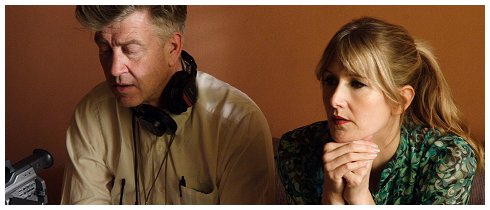
Lynch and Dern have collaborated previously in 1986's Blue Velvet and 1990's Wild at Heart. In this interview, the two talk about the making of Inland Empire. Fans of Lynch may be interested to note that in Twin Peaks-ish turn, this interview was conducted at the atypical venue of Marie Callender's over an assortment of pies.
|
The Interview
|
MEDIA: David, There seemed to be different styles of shooting in Inland Empire compared to your earlier works. Did you take a different approach filming this one?
DAVID: Yes, because I was shooting DV with a small, lightweight camera. It was so beautiful to me to be able to hold a camera and float around and let it move according to what I was feeling or seeing, whereas before, you're behind a massive camera, in front of you is an operator and a focus puller, and you've got a kind of a barrier. Even if you wanted to move, it wasn't possible. Like I say, the next take you might say, "Can you drift in on this line a little bit like this" but it may not happen the same way the next take, so it gives you this ability to really kind of be in there and stay in there because it's 40-minute takes. It's very beautiful.
Laura, how did this experience differ from your previous collaborations with David?
LAURA: You know, again, I'll almost repeat the same idea of liberty that comes with working this way--that you're liberated as an actor in the same way David describes. You never miss anything because you're right there. You never miss an opportunity of being in the moment because suddenly now, not just performance, but the camera is offering that "in the moment" opportunity. You can catch anything and he can hear what the actor seemingly off camera is doing and want to capture that and just flip around, and because of the luxury of a 40-minute take if you need it, you can shoot an entire scene without ever stopping, and he could get all the coverage he wants, and we are staying within the moment of acting out this scene and not cutting and resetting, but in fact, even while filming, talking to me because the luxury of the lack of expense as well, to say, "Let's do it again. Okay, go back to this line. Let's keep going." And as an actor, it's just an incredible feeling to stay true to the mood, the feeling that's going at that given time.
David, how does Inland Empire relate to your other works thematically? There seem to be similarities to Mulholland Drive, and we actually see segments of Rabbits within this film...
DAVID: It's different but [with] similarities because it still deals with, as Mulholland Drive did, the movie industry. And it has, you know, a female lead... [laughs]
LAURA: [to David] Thank you.
DAVID: Then it kind of takes off and becomes different.
In a way, it seemed like a collage of some of your previous films. Was that intentional?
DAVID: No. Ideas come along, and sometimes you catch an idea that you fall in love with and you see the way cinema could do that. It's a beautiful day when that happens and the idea tells you everything. Because we've got our own kind of mechanism, we kind of fall in love with certain kind of things. But every film is different, and it's based on the ideas that come, and they are the things you try to stay completely true to and all the elements you try to get to be feeling correct before you walk away.
|
|
Laura, your performance in this movie requires so many different levels of persona. How did you approach the task?
LAURA: You know, more than ever, the day's work was at hand and what I had...David would write a scene and we would film that, and then he would write another scene and we would film that, and so on. It forced me very luxuriously into the moment. I didn't necessarily know what would come before or what was coming after and whether one perceives it that I am different people or that I am aspects of one person. Either way, you can really only act that one way which is being the person you are in that moment. So in a way, not knowing everything [helped]. I was freed from any of that by David keeping me in the moment with whatever character I was playing or whichever aspect of the story I was involved in. And that was extremely freeing, and, in a way, I think allows for more imagination as an actor, because as much as an actor wants to believe, I think that they are not informing the audience, there can be a pitfall of feeling like "Because my character is going to do this five scenes from now, maybe I should give them a little bit of a taste of that so they know it's coming." But as we see, human nature doesn't work that way, and we're deeply surprised in the news...And so being forced by the director, if you will, to just be this aspect of what I'm supposed to explore, I think made me get to be braver by default, not intentionally.
So is David the only director with whom you'd want to take this scene by scene approach?
LAURA: Well, I would rather only work with David, period. [laughs]
DAVID: That's because she's working with him now. Watch what happens next time. "I only want to work with Robert, or I only want to work with..." [laughs]
LAURA: But I think for myself...I watched David do this with many other actors on this movie, but I don't know that I could have done it with many other directors. We've been asked if we have a shorthand, and in fact, we have a remarkable one. I'm sure he has it with the other actors he works with, but for me, I have the ability from knowing him since I was 17, separate from who he is as a director to me, to intuit what he needs. And he can intuit what I'm going to express before it happens. So it's not just what the movie's about or the character I'm playing. But even as an operator, a cinematographer, I felt like David moved his body and the camera into place just when I was thinking of moving that way.
DAVID: Laura actually directed this picture. [laughs]
LAURA: I did. [laughs] And he was wonderful. We cut his part out.
Did you consider releasing this as a set of short films?
DAVID: No...You know, after a while, the scene by scene revealed more, and then I wrote a lot of stuff and we went and shot more traditionally. You know, we could shoot for several weeks and have stuff to shoot and organized like a regular shooting schedule. But it was just in the beginning that it was scene by scene, and those could have ended up just being that--a scene, separate, by itself for the internet or whatever. But I didn't know what it was going to be, so I'd shoot a scene, and then I'd get an idea for another scene, and shoot that scene, and lo and behold, after a bunch of them, a thing came out.
Laura, your opening scene with Grace Zabriskie is so creepy. When you're actually filming it, is the moment that tense? Or is it not as bad when you don't have the background music and extreme close-ups?
LAURA: Well, I have to say she's the nicest, loveliest lady, but having met her on Wild At Heart, I'm just damn terrified of her every time I see her. I can't get over who she has been made out to be by David when I see her. But you know, it's the beauty of working with David, is that you are, again, speaking of being in the moment. You are there in the moment and you may have a sense that something is disturbing, or a sense that something is funny, but when you're in it, you're just trying to make it as authentic as it is. And then when you reflect back or when you see it as an audience, something that even seemed straight when we were shooting it, to me is just hysterical. Like I pretty much think he's the best company director going. [laughs] But other people may not see it that way. It just depends on how you take it.
DAVID: [jokes] Laura is seeing a psychiatrist.
LAURA: But Grace is hilarious, and when I was doing it, she was terrifying. So I don't know why it worked out that way, because I wasn't sitting across from her.
Thanks for your time.
DAVID: Thanks.
LAURA: Thanks very much.
|
|
|





