
|


|
|
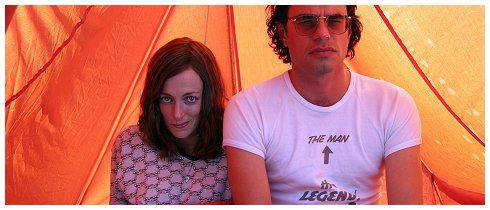
LOREN HORSLEY and TAIKA WAITITI
on 'EAGLE VS. SHARK'
Contributed by Michael J. Lee, Executive Editor
for Radio Free Entertainment
June 5, 2007
In the quirky comedy Eagle vs. Shark, a sweet but awkward wallflower named Lily (Loren Horsley) takes a liking to Jarrod (Jemaine Clement), a dorky outcast brimming with unresolved aggression. After a quick and sudden courtship, Lily accompanies Jarrod on a trip back to his hometown, where she meets his family, who seem to prefer her company over his. As a series of comedic events unfold--all leading up to Jarrod's ultimate plan of exacting revenge on a former school bully--Lily comes to a better understanding of her new beau, and whether or not he's the right match for her.
In this interview, Loren Horsley and writer/director Taika Waititi talk about the making of the film, which was shot in their native New Zealand.
|
The Interview
|
MEDIA: What was the casting process like? You had some really eccentric characters that worked well...
TAIKA: Yeah. Well, Loren's character, that was like a given right from the start. She was going to play that character.
LOREN: We cast the film together.
TAIKA: Yeah, and a lot of the characters were written based on certain people, or like with actors in mind, just thinking, "This guy will be great for this role." And the actual casting, we didn't actually audition that many people. We just sort of screentested our first choices, and a lot of time, they were perfect.
LOREN: New Zealand has got lots of the actors [who] do lots of theatre, because there's not a lot of film, and it's kind of really rubbish TV. [laughs] And so there's lots of really fantastic character actors around the place that we know and have worked with, and so...at last we got a chance to pull them in and give them something to do.
TAIKA: Yeah, and in some cases, a lot of the actors are really just playing themselves. You know, there are a couple of people who had never acted before. I mean, like the kid who...you know, Jarrod's nephew who's like the big guy. He's got the band with the little girl and the ponytail. And he plays guitar and stuff. And I wrote a character based on him, because I had met him when I was in my friend's house, and I just found him this incredibly weird kid. And I just wanted a character like that in my film, and then eventually just cast him as the character. I didn't think I'd find anything better. So yeah, and he was exactly what I wanted. [laughs] So it was great.
Loren's character Lily starts off as an employee of "Meaty Boy." Is that a real restaurant in New Zealand? Do you have any stories from the fast food frontline?
TAIKA: A friend of ours used to work in Kentucky Fried Chicken. And their store manager used to come to work with a brief case every day, and he was wearing a suit and was very professional. And all the other employees used to wonder what was in the briefcase, and they're like, "Why do you need a briefcase to come to work managing KFC?" And eventually like after a few months, when he wasn't looking, he had gone off to do something and they snuck into the office and they opened up his briefcase, and inside it was a single apple and a bottle of Prozac. [laughs]
LOREN: It's true. It's really a true story. We remodeled that...That's the exact store where he worked, but we didn't remodel it to look [the same] obviously.
TAIKA: So Meaty Boy doesn't exist. That was the KFC, and we changed everything. So I didn't want to have a world where anything was very specific and that anyone could relate too much to. And so we made up the video game. That was based on a game called Mortal Kombat, and it's a very...
Why was Mortal Kombat the inspiration for the fake video game?
TAIKA: Well, I love video games, but I never really get into the new kind of games. I really like arcade games, and like the '80s and early '90s kind of games, just because there's a real kind of naivete to them, but there's like a real inventiveness to it as well. And so Mortal Kombat, that was a huge game for us, and it kind of blew everyone away because it was like this photographic game.
LOREN: I think you were 10 or something, right?
TAIKA: Well no, I was 15. But yeah, that's another one of the elements in the film that was made up. You know, we made up this game, Fight Man. And also, I guess, it's just nice when you watch a movie and you see a little bit of effort has gone into the production design, where they've actually created new things. And you automatically know it's Mortal Kombat, or you know that it's a McDonald's or a Burger King. But it just helps to set it in a slightly different world as well.
So Loren, are you as adept as Lily (aka "Dangerous Person") at pulling out people's spines?
TAIKA: No...
LOREN: Absolutely not. No, I was raised without a television, and I have a loathing for video games of any sort...Joystick, is that what they're called?
TAIKA: [laughs] Aw!
LOREN: You know, the thing. I had to get lessons on how to look like I [knew how to play]...
What was the reaction of the locals who saw you filming?
LOREN: New Zealand is a really odd, "we're not even going to look at you..."
TAIKA: We've got a thing called the tall puppy syndrome in New Zealand where if anyone is doing really well, it's quite common to try and bring them down--like cut them down and say, "You've been to the moon? So what? I mean, plenty of people have been to the moon." Even before Lord of the Rings, a lot of films were made in the cities and stuff and they were a few other American productions made there, and I think a lot of people really don't really care about seeing a production. Obviously, anywhere you go, there's always somebody who likes to just look. But also I think in New Zealand, the chances of actually seeing a star are so slim. People kind of just think, "Well who am I going to see, like some guy from a New Zealand soap opera who I see in the supermarket anyway?" So those sorts of things are never really a huge deal.
|
|
Now for the million dollar question: What are both of your favorite animals?
LOREN: Mine just changed. Mine was baboon until last night when Taika showed me this BBC Planet Earth...Their latest documentary. Have you seen it? Oh my God!
TAIKA: I don't think they were Amazonian. They were from the Philippines or something.
LOREN: It was a parrot...
TAIKA: A bird of paradise.
LOREN: ...that you've never seen before ever in your life...He looks like a squid, but it's a bird.
TAIKA: A big black bird with like a strip of blue with these two blue things that look like eyes...It's her favorite bird...And now she's given up baboon and it's now my favorite.
LOREN: The birds are amazing.
TAIKA: A baboon that could fly would be pretty cool.
Why did you choose an eagle and a shark for this movie?
TAIKA: I'm not sure about the specific symbolism about an eagle and a shark, but for me, they represent the loneliest of the animals. Very solo animals. They both circle around looking for something--running around and around in circles, but are in just completely different environments. They're very different, but also very similar as well.
Could you talk about the costume design for the characters, especially the eagle and shark outfits?
LOREN: I was wearing a wig, so automatically I had great fun. If you put a wig on, then you're finished. I don't know if you watched any of the dailies, but that costume was so uncomfortable. It was just genius...It wasn't the nicest thing to wear, but they're beautiful costumes. The costume designer made them all from scratch. She kind of stitched around them. Taika kept on saying, "No, they have to be made worse."
TAIKA: The original costumes were really well made and I wanted them to look more like...these guys made the costumes themselves. And we originally wanted you guys to actually make them themselves, but there was just no time. Once we got into the second week of pre-production, everything spun out of control. It was like there was no time to do anything but make the film.
Why did you choose to insert animated sequences throughout the film?
TAIKA: Well, that actually kind of developed a little bit from the script stage right through the very final edit, where we had these little...we had like maybe one...originally there was going to be one moment of animation, and that kind of threw everything a little bit too much. And then the animation story broke into two, and then it got chopped up a lot into different moments, which I think some audiences kind of freaked out when they were watching the film and then sudden it breaks into this new format. And I think a lot of people couldn't handle it. So yeah, we kind of tied it right in from the very beginning, created it and saw it through to the end. It actually works better, I think. Yeah.
LOREN: And that's because you love animation. Animation is Taika's favorite thing. So any chance to put it in would be great. And then he'd always say, "This is my low budget, my first feature, I can do what I want." And we didn't think anyone would see it apart from New Zealanders.
TAIKA: Yeah, originally, we never really thought that this film would do anything, except maybe a few festivals here and there, because it was a very small, intimate New Zealand film. And the only New Zealand films that do well are like dark family dramas where kids die. And so it's definitely, I think it's a new development for New Zealand cinema to have comedy, and especially romantic comedy, get as much attention as this one.
There is a stop-motion photography sequence in which Lily and Jarrod are rolling along a hillside in sleeping bags as the sun sets. How long did that take to shoot? Did you spend the whole day being dragged around in a sleeping bag?
TAIKA: That was like about 5 or 6 hours of shooting that stuff. There were extras in there.
LOREN: There were doubles. I did it in Sundance. That's what Taika made us do in Sundance, which was like 2 hours...I have a high tolerance for doing stuff, but this was against all rules. It's like you move, stop. You move, stop. For 2 hours.
TAIKA: Everybody was sunburned at the end of the day. We were off shooting other stuff and we just missed them with the second unit crew.
LOREN: And they were crawling through cow dung.
TAIKA: And they were crawling on grass patches with prickles and stuff and cow sh*t. It was so funny.
LOREN: They were weeping at the end.
Were there any scenes that you had to cut, to your regret?
TAIKA: There was a dream sequence actually that we shot.
LOREN: Sort of Ingmar Bergman.
TAIKA: It's a very Bergman dream sequence in black and white that was shot for the film where Lily has gigantic robotic arms from the video game and she's on the beach fighting seagulls and that never made it to the film but it's something that I really want to be on the DVD. It's funny, the film commission gave us this money and basically gave me complete creative control. Left me alone. The one time they came to see it was the day that we were shooting the dream sequence and they turned up.
LOREN: I was covered in blood.
TAIKA: "What's going on here? She's got blood all over, pretending she's fighting these seagulls, and I'm yelling out, "Okay, they're pulling your heart out of your chest! Fight them off!" And they're, "Your film looks interesting, Taika."
LOREN: They smiled and nodded and walked away really quickly.
What's the one thing you'd like an audience to take from this film?
TAIKA: [jokes] A receipt. I think it's important to me that people don't go into this film just thinking, "Okay, it's like a broad comedy that's good for a couple of laughs for a hour and a half and then you can forget about it." I hope the film connects with people on a deeper level and that people realize that we are all outsiders. And that this is one of the main themes for the film, is that you can connect to that fact that none of us belong and it helps to ground you a little bit more in the fact that we're all together in this and it's not a film where you laugh at people who are different. It's a story about recognizing that we all are those people. They're just extreme versions of ourselves.
LOREN: We can wake up the empathy that are part of people's natures. That would be good.
TAIKA: My big theory is that human's are the outsiders in the animal world, and we're like the nerds of the animal world and we don't fit in, and they're all secretly looking at us and shaking their heads and saying, "What are those things?" When you think about it, we've evolved so much now that I just don't think we belong here anymore. These clumsy ridiculous animals---we're not even animals, we're just like strange awkward clumsy beasts.
|
|
|





