
|


|
|
CHRIS COOPER on 'BREACH'
Contributed by Michael J. Lee, Executive Editor
for Radio Free Entertainment
February 3, 2007
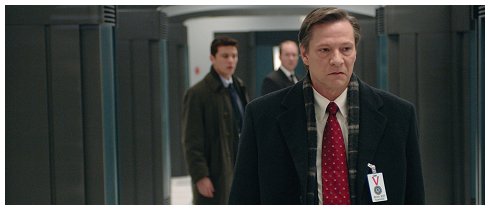
Based on what many consider to be the biggest security leak in the history of U.S. national security, Breach is the story of FBI agent Eric O'Neill (Ryan Phillippe) and his attempt to capture Bureau mole Robert Hanssen (Chris Cooper) in the act of espionage. The film explores the complex relationship developed by the two men, as well as Hanssen's contradictory duality--a seemingly religious and dedicated patriot who was betraying his country with little or no remorse whatsoever.
The dramatic thriller features Laura Linney and the awesome and underrated Caroline Dhavernas (TV's Wonderfalls, Hollywoodland) in supporting roles as O'Neill's boss and wife, respectively, who add extra dynamics to the pressure that the agent faces as the case progresses.
In this interview, Chris Cooper--who delivers a strong performance that is both subtle and menacing--talks about getting into the mindset of Hanssen and working on the project.
|
The Interview
|
MEDIA: What was the first thing you did when you got this role in terms of research?
CHRIS: The first step certainly was to find if there was any research material, and there turned out to be a lot. I looked around the house, and I was trying to refresh my memory because this was coming up, and I ran into at least five of the books that I used, and they are pretty in-depth studies about Hanssen from his childhood all the way to his capture. And they were very, very helpful, and then of course, we had the true Eric O'Neill made himself available for about a week before we started shooting, and both Ryan and I would spend anywhere from 10 to 12 hours a day just peppering him with all sorts of questions, and just any bits of information he could give about Robert Hanssen and their relationship for that period that he was shadowing Hanssen. So there was a lot to draw from.
How did you come to be a part of the project?
We talked with Billy Ray, the director, and asked if he was interested in my coming aboard, and I believe Billy than approached Universal and asked them, did this sound like an okay thing with them? And they backed and supported me, and the great thing was to realize about four to six weeks later, once word got around this community that we had a good script, there were some very big names knocking at Universal's door to see if they might be able to knock me out of that position. But Billy and Universal stayed with me, and I feel very fortunate.
Did you feel intimidated to play a real person versus a fictional character?
The intimidation was to...though there were some pretty embarrassing and treacherous acts committed, I still felt responsible and respectful of primarily Hanssen's family. No doubt this is a terrible embarrassment for the country and his wife Bonnie and his children. And I think the script handled some rather embarrassing aspects of that very tastefully. But intimated? No.
Did you ever have the opportunity to visit with Hanssen?
That would be impossible. He is in a super max prison, and I believe to this day he's caused so much trouble with the amount of information he gave the Soviets over a 15-year period that from time to time, he may well still be interrogated on occasion.
Do you think there is a chance he will see the film?
I don't know. I saw a documentary on the prison where I believe he is, and I don't know if they are granted reading material or televisions. I don't believe they are. But who knows, you know? He may have some friends in the guards there and he may get to view it someday. I don't know.
In the film, Hanssen has a particular attraction to Catherine Zeta-Jones. Was all of that stuff true?
Yes. [laughs]
|
|
What are your thoughts on Hanssen's personal motivations?
Well, when he was captured, they certainly did a pretty thorough psychological evaluation of him. And if memory serves me, they...I think we played on probably four possibilities touching on why he did this, why he did what he did. And some, the psychiatrist's interview...I remember some quotes suggesting that the roots of this may well have begun concerning the relationship with his father. And it started at an early age. I mean, this book that he read, he claims he read it at 14, it was actually at age 24...But...I think another motivating factor that I tried to justify that I just used as a possibility, I believed him to be truly a very committed, dedicated, religious person. And in that study, they suggested that he had very strong psychological demons that he was dealing with. He had a...he was terrified of failure, of not looking good in the eyes of his wife and his children. He expected to rise higher than he did in the FBI. I think he...he did rise, but only to a certain level, and because of his intelligence and his working knowledge of early computers of that time, he was placed in a position where he ended up not being one of the "guy" guy FBI, but sitting in front of a monitor and reading reports, and I think that may have been real discouraging to him and probably very irritating. I think probably angered him quite a bit.
Did you have a discussion with writer/director Billy Ray about Hanssen's religious fervor?
Billy and I touched on that. That was more my responsibility to, how far I went, and my...I'm not Catholic, my wife is. [laughs] A friend of our...another actor friend, Patti Clarkson, because we're going to be working with her, she gave the house a call and Marianne picked up the phone, and it was a Saturday night, and Patty said, "Well what are you guys doing tonight?" And Marianne said, "I'm teaching Chris the rosary." And I had no idea how lengthy a rosary could be and how involved it was, you know? But...The religious aspect was all my responsibility to...how serious and what religious fervor he held for Opus Dei and the Catholic religion.
Can you talk about working with Ryan Phillippe? We heard you auditioned with four or five actors for his role...
Yeah, I did come over to...I came over to Los Angeles. I think we were looking at working with six actors throughout the day, and we found a little sound stage with a garage door, because we were working inside and outside on some scenes, and the six talents that they chose were...you all would recognize them, you all would know who they were. But it just came out that Ryan was the better performance of all of them, and that was Billy's choice. The working relationship was just terrific in that we had some very strong, serious scenes every day to do. So what I appreciated in Ryan was that...it was certainly not...I think the day of our introduction was probably the nicest I was to Ryan, and I preferred to keep it that way. And that's the same method I used to work with Jake Gyllenhaal in October Sky. It didn't call for a chummy atmosphere on the set, and that was fine with Ryan, and it was necessary for me. I think Ryan and I kind of work in similar ways. I think in many respects, we're...at the moment of performance, we're intuitive. There's a lot of pacing by both Ryan and me. And between scenes...That was a memory of mine. He'd be at one corner, I'd be at the other corner. But the atmosphere was appropriate. And it wasn't the most joyous or chummy, but it's what we needed to do the work.
How valuable was it shooting on location where some of these events actually took place? Did it help your performance?
Yeah. In a subtle way, but it was an extra big layer. You're in this neighborhood and you're retracing the steps of this guy. [laughs] And...you know, if you saw the film, where the car is parked and I'm about to get in the car to drive off, that house behind the car...I can't remember her name, but she was such a cute lady, I guess in her 70s or so, and she had t-shirts printed up. "Hanssen Was Captured Here." And she was very accommodating to the cast and crew.
Did you get one?
I didn't. But it really gave you a sense of re-doing, re-walking history.
Were there any specific anecdotes that the real life Eric O'Neill gave you about Robert Hanssen that were helpful?
Yeah. He was saying, and we did incorporate it into the film...some people had different interpretations of it. But the scene where I'm walking and talking with O'Neill down the hall and I sort of drive him into the furniture or the wall or whatever...And Eric never knew, is this intentional, or is this another intimidating tactic? And I just didn't go that way. I went with...when this guy is involved, his gyro just gets off. His physical sense just goes an odd way. Eric would tell us of all the mind games that Hanssen would play, and Hanssen never kept that proper social distance...And he'd always come around the table to where Eric was working, and he'd just hang behind and on occasion touch him. It was very creepy for Eric. And those instances, those close calls, when it was so close that Hanssen might have discovered that Eric was a set up to shadow Hanssen.
Thanks for your time.
Thank you, guys.
|
|
|





