
|


|
|
CHI McBRIDE on 'LET'S GO TO PRISON'
Contributed by Michael J. Lee, Executive Editor
for Radio Free Entertainment
November 10, 2006
Although he is probably best known for his work in television dramas--from guest appearances on House to starring roles on The Nine and Boston Public--Chi McBride has enjoyed an impressive and varied career that has also included comedy. Hardcore TV fans will remember him as the title character in the short-lived The Secret Diary of Desmond Pfeiffer, an irreverent sitcom that made the bold and interesting move of using the Lincoln administration as its backdrop for laughs.
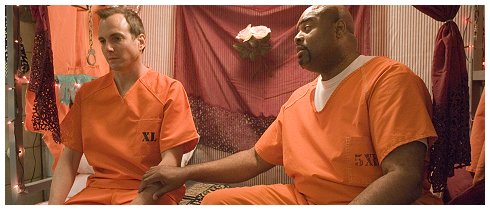
Since then, Chi has tackled comedy on the big screen in Magicians, Undercover Brother, and Waiting. In this interview, he talks about working on Let's Go To Prison, a no-holds-barred flick that follows two men (Dax Shepard and Will Arnett) in their misadventures through the penal system. The movie is inspired by You Are Going To Prison, a cult classic survival guide for the slammer, and features Chi as the head of a prison gang who has his eye on Will Arnett's newly-incarcerated character.
Let's Go To Prison opens in theaters on November 17.
Click here to watch clips from the film.
|
The Interview
|
MEDIA: So many TV fans know you from your dramatic performances on Boston Public and The Nine. With this movie, did you relish the opportunity to show you could do a "don't drop the soap" joke as much as the next guy?
CHI: Well, yeah. I mean, I try to make my choices be driven by material, and I love the opportunity that I've been afforded to do both comedies and drama. And with Prison, it was such a dark, subversive comedy, which is right up my alley. I don't want to do any mild-type comedies. I like to do specific kind of work. Just like in doing The Nine, I'm playing a character that's completely different to any way that you've been used to seeing me. And to the credit of the creators, Hank and K.J. Steinberg, most times, when you go to producers and tell them that you want to have a different look, you want to put on a wig and a mustache and some glasses, they're like, "No." So they were right on-board from the beginning with me creatively. And that's what I loved about doing this picture, Let's Go To Prison--it was dark, subversive, and different than any way that you've been used to seeing me. And I think that's the challenge for any actor, to just try to avoid doing the same thing over and over and to become predictable, where people think that they know you and they know what you do. And this is a business where people will only let you do what they think you can do. And I'd like to let them think that I can do a lot of different things.
How did you develop the rather intimate prison relationship with Will Arnett?
"No men were kissed in the making of this movie." It was easy, man. I mean, to play that kind of relationship, you just play it as though you were playing it with a girl. That's what makes it funny. The realer it is, the funnier it is. When you really try to play up certain aspects, it's the intimation of what's going on. It's the implication of what's going on. The playing of that is what makes it real...[And] you can leave things to the imagination. And that's what we've done a lot of in this movie, is we leave things to people's imaginations.
So does Will's character eventually come around to you?
[jokingly] Look at me, man. Who wouldn't come around? Come on. Of course he does. He submits!
How did you first get involved in this project?
My agent called me with this script, and she said, "You're either going to really like it or you're going to really hate it." And I read it, and I was like, "Yeah! I'm on-board!" You know, I use the words "dark and subversive" a lot, but that's what it is. It's humor that you don't know whether you should be laughing or not. I love that sort of stuff. I love movies like that, that make people laugh and then look at their friends and say [apologetically], "That's not funny." So that's the quality of the humor that really attracted me. And I love [director Bob Odenkirk's] sense of humor. I just did another picture with Bob and Will, as a matter of fact, called The Brothers Solomon, that releases next year. More of the same. And the character I play in that is a very acerbic and cynical and quick-witted guy, and I really loved playing that character. So those are the things that really attract me to comedies.
Is this one of those movies in which the trailer gives away all the funny parts?
[laughs] No. There's more. I think that when I saw the movie, I laughed out loud most of the movie. I think that Dax is very, very funny, and so is Will. And I love the character that I play in it. And there are some really great lines in it, and some great sight gags. And Dylan Baker's really funny in it, and so is [David] Koechner. I mean, we got some funny people in this movie...It is as advertised.
What were some of your favorite scenes?
The scene with me and Will together in the cell, when I first start coming on to him, is pretty funny. The last scene in the movie's pretty funny. I mean, there's a lot of stuff in there that's really, really funny. A couple very funny montages, when I first meet Will. There's another scene in a bathroom that's pretty damned funny--there's some really good stuff in that one...I enjoyed the whole process of shooting the film. I loved working with Odenkirk. He's a fast and efficient director, and he knows what's funny, and he trusts his actors. He really gives us the opportunity to do what we were hired to do. A lot of times you work with people, and they forget why they hired you. And that's why, as much as a lot of actors want to get offers for stuff (and I get offers for stuff in TV), I would rather audition for people, because I don't want to have an arm wrestling match with a guy every time I come to the set. "See what I'm going to do, and then if you don't like that, don't pick me." And we never had those kinds of problems with Bob because he always trusted us.
|
|
Did you go to any prisons or talk to any inmates to get a better idea of your character?
[jokingly] No, I'm not one of those guys who actually has to shoot heroin to play a heroin addict. Of course, I'd probably do a lot more research if I were playing a gigolo. But we actually shot the movie in the Joliet state penitentiary, in Joliet, Illinois. It was right outside my hometown of Chicago. And there was a lot of bad dudes who have come through there: Richard Speck, John Gacy. Dahmer was there for a minute before they transferred him to Wisconsin, where he met his deserved demise. (I'm sorry, are there any Jeffrey Dahmer relatives [present]?) But no, there was no need to talk to any inmates, because when you're actually in prison, it's not that funny. So I didn't have any reason to talk to anybody about their experience. [laughs] Can you imagine? You go to like a guy who's committed a quadruple homicide and he's in there for life, and say, "Hey man, so what's the funniest thing about prison for you? What do you enjoy more than anything? Is it the gang rape?" So no, there was not an extensive amount of research, no.
And you probably won't be doing any screenings of the film in prisons, right?
I'm not! If Universal wants to take their asses over to Corcoran and see how the inmates like it, they are welcome to do so! Because if you're in prison and you're doing a screening, it's not even necessarily cool if they like it. They might riot. You know what I mean? "This is great! Let's kill everybody!"
When you're reading a script, do you get a visual image of your character?
Yeah, you get an image. You get pretty much a movie in your head if the material is written well. If it's written the way good writing is supposed to happen, you can see it. Just like when you heard Richard Pryor do his routines, you could see that stuff, man. You could see an old guy all bent over named Mudbone. You could see the stories that he was telling. They would just come to life, and that's because they were well-written and well-executed. And that's what happens when I end up choosing something--it's because I can respond to it in that way.
You've stuck with TV roles despite the potentially lengthy commitments. Are you more attracted to television's ability to develop a character than a movie's ability to do so?
No. I mean, I'm attracted to good material. If I like the material, then I give it a shot. I've only done one thing in my whole career, I think, where I thought the material could have been better, that it was a little suspect, that maybe it would be better because of the pedigree of the person attached to it...And that was Killer Instinct. Or as I used to call it, "Kill It, It Stinks." Other than that, I choose things based on material. So it doesn't matter whether it's a feature. I've been very fortunate in that all the while that I've done television, the producers have always let me out to do films. And I've had some help. I remember when I did The Terminal and I auditioned for Steven Spielberg, he got on the phone and called [Boston Public producer David E. Kelley], and David let me out so that I could do it, which was certainly a boost to my level of confidence in my ability. So as long as I'm able to go back and forth, I would not choose one over the other.
How have you felt about seeing your face on all the billboards around town for The Nine?
It's pretty surreal, you know what I mean? To be honest, it's quite humbling, because seeing that and knowing that other people look at that and perceive something...I look up there and say, "I got hair coming out of my nose." So I don't take it too seriously. There is no rhyme or reason to it. It comes and goes. Easy come, easy go. It can all go away in a minute. It's a part of what we do. And if studios think that putting my face on a billboard will help make people want to watch something, then that's good. That's good for my career. And that's as far as I take it. I don't have a vanity attachment to it.
Is there a particular role that you're eager to play?
I would really love to play Jack Johnson. Jack Johnson is probably the most controversial and multifaceted black man that this country has ever seen. He was the precursor to Muhammad Ali. And he was Muhammad Ali in the 1920s, which seems unbelievable that a black man, especially a dark skinned black man in 1918, is driving through the South at 80 miles an hour, and gets stopped by a cop, and says, "You might as well give me two tickets, because I'm going to be going this fast on the way back." You know what I mean? A guy to have those kind of stones in those days? When people were just hanging people from trees just for being black? So a character like that...Yeah, I'm dying to play that. And I don't know that anybody can touch what James Earl [Jones] did in The Great White Hope, but that movie hasn't been seen in a long time, that story hasn't been told. And when Ken Burns did his piece on Jack Johnson, it made me want to play that role.
Thank you for your time.
You're welcome.
|
|
|





