
|


|
|
SAMUEL L. JACKSON on 'LAKEVIEW TERRACE'
Contributed by Michael J. Lee, Executive Editor
for Radio Free Entertainment
August 19, 2008
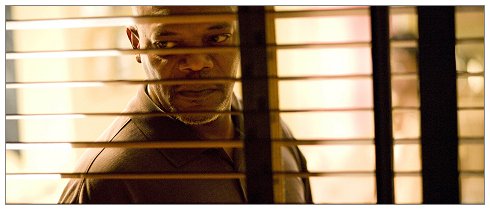
In the thriller Lakeview Terrace, strict single dad and LAPD officer Abel Turner (Samuel L. Jackson) finds himself at odds with his new neighbors when a young couple (Patrick Wilson and Kerry Washington) move in next door. The situation quickly deteriorates, and it becomes clear that Abel's grudge against the newcomers runs deeper than a casual dislike--his emotional state becomes increasingly erratic, and this figure of law enforcement soon poses a deadly threat to those he was to serve and protect.
In this interview, Samuel L. Jackson talks about working with director Neil LaBute, and developing his unnervingly intimidating antagonist in this tale of one-upsmanship between warring neighbors. And in an amusing aside, he also takes a brief moment to comment on the 2008 Olympics in Beijing.
Lakeview Terrace is now playing in theaters everywhere.
|
The Interview
|
MEDIA: In creating your character Abel, were you able to directly draw upon people you know in real life?
SAMUEL: Not really. I mean, I know people that are that kind of crazy, and we've all encountered people who have definite ideas about how they want things to be, and they're dogmatic in that they don't go either side of that line--they're like, "This is what it is. And that's all that that is. There's no room for any other opinion or anything else." And I think Abel's one of those guys.
It can be argued that he's not really a villain at all. What's your take on Abel as a bad guy?
Believe me, there will be some people sitting there watching the movie that'll be on Abel's side. I mean, [Patrick Wilson's character Chris] is flipping his cigarettes over the fence, and he is sort of a smug kind of a**hole, and his friends do kind of talk down to Abel when he's at their house. And it's spontaneous, but [Chris and his wife are] f*cking in their pool, and there are kids next door, possibly. And there's stuff happening there that either one or both of them could feel a certain way about each other. So Abel's got his point, and [Chris has] got his point, too. But I wanted to create a character that people could actually look at and see his side of it. And Abel does have a right to want his neighborhood to be a specific kind of way. He does have a right to raise his kids the way he wants to raise them. As a single parent, he's got to be diligent, and he's got to be kind of strict. There's a bad influence that lives around the corner, or down the hill. He's got to deal with that. So he has a right to be this strict, hardline kind of cat. The only thing that we're kind of vague about is really what his problem is with this couple in terms of what happened to his wife, and that tragedy that formed this opinion that he's got right now.
In which scene do you feel he is at his most intimidating?
Hmmm...I kind of think the chainsaw [scene], when he's cutting down those trees, because then you see he's unhinged--that there is a bit of something there that's kind of crazed, that's gone, that crosses the line.
In the scene where he threatens a guy with a shotgun, do you feel he demonstrates corruption, or was he just an awesome vigilante?
Well, not a vigilante because he's got a badge. [laughs] He's "forceful responsibility," explaining to this young man that he has a responsibility to his wife, to his kids, to his community, to himself. And ordinarily, he had a right to kill him. The guy did discharge a weapon at him. He could have killed him. So he was actually being kind to him by not killing him. He was just making a point. And making a point "in a police way." Because cops do that.
So in his mind, Abel is doing good...
And he is a street cop that wants to be a street cop. He likes that life. Not just because he's got power, but because he feels like he can make a difference. And like I said, he has his idea about how he wants the world to be, and he's doing his part to see that it is that way.
Abel seems to have a problem with everyone in his neighborhood, with the exception of one Asian couple. Why do you think he gets along so well with them?
[laughs] He doesn't have problems with everybody in the neighborhood. He has problems with the next door neighbors, and he's got a problem with the guy that beats up his wife.
And the drug dealer...
And the drug dealers, he probably doesn't even talk to those guys. He just knows that it's going on. They know he knows. But the Asian couple... [laughs] Because they like his food. [laughs]
Abel's fellow cops don't necessarily seem comfortable around him. There's a moment of awkward silence when he walks in on their conversation...
Yeah. Well, I was the one that actually created the moment where I said to Neil, "If they're going to get quiet, then there should be a reason for it." And the reason was they were getting ready to have this bachelor party, and they probably didn't want him there because they know he's like a straight-laced, law-and-order kind of guy. They didn't know he was going to be, "Okay, let's get some buck naked chicks over here." I also had arguments with the producers about that. Because it's like, "It's a PG-13 film, so we can't have t*ts." So I'm like, "What kind of drunk cop party is there where there's like a girl with f*cking clothes on?" And they're like, "Well, it's PG-13 and we can't have breasts." I said, "Well, can you shoot their naked backs so the audience will assume we have them topless?" "Uhhh...No."
|
|
[Editor's note: The next two questions contain spoilers about the film's resolution. Check them out after you see the movie, unless you don't mind the knowledge.]
It's not often we see your characters get beaten up or taken down. Did you have fun being the fall guy this time around, and even getting a death scene at the hands of the law?
You know, that was one way that the movie could end...But that was like a big argument between me and the producers for a minute, because I didn't want him to die. Because in real life, cops take care of cops...I kept saying, "What if everybody gets arrested, and two weeks later, here these two guys are out watering their lawns, and they're just staring at each other, like, 'F*ck you.'" Because that's the way life goes...Cops get away with sh*t, because cops take care of cops...But they kept saying, "Well, the audience needs to see the bad guy die." And I'm going, "Well, who the f*ck's the bad guy? I don't think I am!" Even though I did go to [Chris'] house to... [pauses at the irony] kill him.
No matter how they take you out, let's be honest: is there any way to top a death scene like the one you had in Deep Blue Sea?
[laughs] Actually, no. Not at all. Everybody loves that!
What did you like about working with director Neil LaBute?
The fact that he is a writer, and he does direct theatre, plays. The only other director I had that was like that was Roger Michell on Changing Lanes. So they're a lot more concerned about the character, the story, what's going on between the people, how the people interact, what they say to each other, what those particular things mean to the story itself, how it moves the story along--and not necessarily the composition of the shot, or the cool camera move that's coming. "Watch the cool camera move that's coming!" "We're acting over here." "Yeah, but the camera's doing this..."
Is it distracting when the camera tricks become the main focus like that?
It's not distracting, but I ask myself, "Where the hell is this going in the movie?" Come on. The MTV audience even gets tired of that sh*t. [yells] "Keep the camera still, I'm trying to watch what the guys are doing!"
Before becoming a movie star, did you ever have a cop encounter where you felt helpless?
Sure. [laughs] Don't we all?
Specifically, something where you felt like you were right and they were wrong...
No, you don't judge those kind of things that way. You know, a cop stops you, the first thing you want to do is say, "Good afternoon, officer. Did I do something wrong?" Not, [yells] "Why you stoppin' me, man?!"
You could probably say that to them now, being who you are...
No...Back in the day, I got stopped a lot--because I looked like a person who needed to be stopped, you know? It was just the way it was. I remember back in like '69, I had a Triumph Spitfire, and I made a mistake--had my top down, and had an Angela Davis t-shirt on. I was on Hollywood Boulevard one day. Cops pulled up next to me. He looked, he said, "Pull over." And I pulled over. And there was a guy in the car with me, and they started running my plates. Nothing on me, but homeboy had a jaywalking ticket. Took his ass away, you know? But the whole thing was [about my t-shirt]. "So you really think she ought to be free?" "Yeah." "And how about that boyfriend of hers?" And it was a whole thing about that. It's like, "Take the f*cking shirt off." I took it off, I turned it inside out. Who was the Chief of Police then? When the cops were the Gestapo? The LA police was like feared! You just didn't f*ck with LA police.
Just a quick wandering off topic: have you been watching the Beijing Olympics?
Yeah.
What is your favorite event?
The one I'm watching at the moment. "The one that's on." I keep discovering stuff. Like last night...I hadn't seen trampoline. It was off the hook! I mean, come on. These little girls going like thirty feet in the air off the trampoline--they get some major air on these trampolines! And watching stuff like badminton, because it's not the backyard game that we play. These guys are [intense]. Love the badminton. All the guys like beach volleyball. [laughs] I just love the Olympics. Because I ran track when I was in high school, and I was a swimmer when I was in college, so I understand the events on another visceral kind of level. So I enjoy watching all those events. But it's always good to catch the offbeat stuff that you don't get to see. Like I actually got to watch doubles ping pong the other day. It was insane! You have to hit alternate shots, the other guy's got to get out of the way...It was like, "This is great!" I still want to see some field hockey. They never show field hockey! I couldn't believe they actually made us watch a whole damn marathon the other night. I was like, "There's got to be something else going on we could be watching!" Not to mention, the chick was running away with the race! It wasn't even tight! It's like, "Come on, switch to something else! There's something else happening! I know there is. Somewhere." Girl wrestling--let us watch some girl wrestling! Water polo's good, too.
Thanks for your time.
See you, guys. Thanks very much.
|
|
|





