|
MEDIA: Did you have any particular interest in or trepidation about jumping into the action genre?
RYAN: Well, I've always wanted to see a violent John Hughes movie. And I always thought if Pretty in Pink had a head smashing, it would be perfect. So there's that. And then on top of that, when I was a little kid, when I first saw First Blood, it put a spell on me and I thought I was Rambo. I even thought my face felt like Sylvester Stallone's face when I touched it. And then I went to school the next day, I put steak knives in my Fisher-Price Houdini kit, and I took them and I threw them at all the kids at recess. And I got suspended--rightfully so, and I'm sorry, and I learned my lesson, and I never did anything like that again. But my parents said, "Look, this guy can't watch violent movies." So they put me on a leash, and I could only watch Bible movies and National Geographic movies (which are very violent) and black and white comedies--Abbott and Costello movies and all that. So I understand the effect that movies can have on you, and the kind of spell that they can cast on you. And when I first read this script, I felt like, "Well, this is a guy that's just seen too many movies. He's going around acting like he's the hero of his own action movie." And I wanted to explore that idea. Because I've been wanting to play a superhero, but all the good ones are taken. And I thought, "Well, I could create my own, potentially." And so that's what we tried to do with Drive: a violent John Hughes movie meets a guy who's confusing his own life for a movie. [laughs]
What do you think a young boy who sees Drive will bring to school the next day?
I guess a hammer. I hope he doesn't. Don't bring a hammer to school! Take it from me, it's a bad idea.
What sort of thoughts went through your mind while you were filming the infamous head smashing scene? Was it easy to get caught up in the violence of it?
Irreversible has a head smashing in it, which is the best head smashing that I've ever seen. So we called [writer/director] Gaspar Noe and we asked him, first of all, "Can we do a head smashing?" and second of all, "How did you do that?" So he told us how. But we didn't have the money that they had to do it, so we basically made these prosthetic heads to smash that didn't look anything like the guy, and they were squashed like grapes just with one kick. So it was almost like Who Framed Roger Rabbit or something--it was cartoonish, you know? So when you're shooting it, you're very aware of the falseness of it, so it's different. It's harder to get lost in those kind of things because they're so technical. But I think that Nicolas did a great job of eliminating all of those elements and making it a really visceral and scary, transformative scene for the character. And also, we used like a werewolf metaphor throughout the movie--that the driver thought he was a werewolf and had never turned into one, but was convinced that he had the potential to. And in that scene, the werewolf is unleashed.
 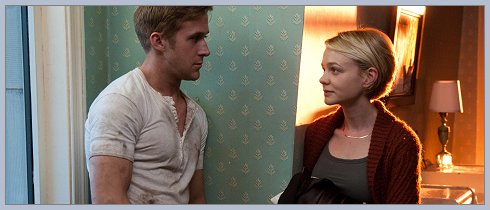
There seem to be a few references to the old fable of the scorpion and the frog. Given that, do you think the driver is inherently tied to chaos, and he can't make a better life for himself even if he wants to?
I think that he's a psychopath... [laughs] And he's delusional and believes that he has this darkness and rage in him that is inevitably going to come out, and he's trying to focus it into something heroic before he becomes a villain.
Do you feel there is a significance to the fact that he goes nameless throughout the story, and that he doesn't speak much?
Well, we wanted the film to feel like a fairy tale, and that Los Angeles is, in a way, a fairy tale land based and built on fantasy. And the only way this movie was really going to resonate on a deep level for the audience--if you weren't from Los Angeles--is if we dug into the mythology of these characters and the story. So we started to treat the driver as a knight, and [Carey Mulligan's character] as a princess locked in the tower, and [Albert Brooks' character] as an evil wizard, and [Ron Perlman's character] as the dragon that needs to be slain. And dialogue, it just wasn't necessary anymore, in some ways...People are smart, they can see how someone's feeling, you don't need to tell them. We just took away everything that wasn't necessary, and it turned out that there wasn't a lot that was necessary. Very little had to be said in order to push this story forward...For us, we were able to say a lot more by cutting out the dialogue.
We understand that you and Nicolas started off on shaky ground when you initially met to discuss the project...
We had a terrible first meeting, and it was like a terrible first date. He didn't talk to me or look at me, he was totally disinterested in being there. Or at least it seemed that way to me in retrospect. I learned that he was high on American cold medication. But it was like one of those dates where you know you're not going to get any action, so you just say, "Let's call it"--you know, get the check. [But then] he needs a ride home now because he doesn't drive. And I'm like, "How could this guy make a movie about driving when he doesn't even drive?" And I have to take him home, and we're in the car, and it's awful, and we're not talking. So I turn on the radio and REO Speedwagon comes on, "Can't Fight This Feeling." And suddenly the guy comes to life--he starts crying and singing at the top of his lungs. And he says, "This is it! It's a movie about a guy who drives around listening to music." Which is how I had been feeling, so I knew that we were onto something. But what I love about the film is that the movie never would have been made if REO Speedwagon hadn't come on the radio. And the movie kept going in that direction, in that we would drive around all night and listen to music, we'd edit the film, and then we'd go to work in the morning and shoot it. And then when we were done shooting, we'd go back to driving around and listening to music, and editing it at night, and watching movies. So watching the film is a good representation of what the experience of making it was like.
How would you characterize Nicolas as a director?
Well, look, ever since Nicolas was a little boy, his mother's been telling him he's a genius, and everything he did was genius--even when he was watching Texas Chainsaw Massacre while he ate his cereal before he went to elementary school every morning, obsessively, she believed that he was a genius. And I think that you get told that enough, eventually, it becomes true. I'm not sure that he really started out as one, but I do believe that he's become one. And he is just a very unfiltered filmmaker. He just makes what he wants to see, and if it's boring to him, he won't shoot it. And he fetishizes things, in a way...He sexualizes things because maybe he can't be as sexual as he'd want to be, so he kind of talks about filmmaking a lot like having sex. And it has to arouse him and it has to be sexually interesting to him, even if it's a pair of gloves, or it's where your hand is in the frame--it has to literally turn him on. And that's unique, and so his films are unique.
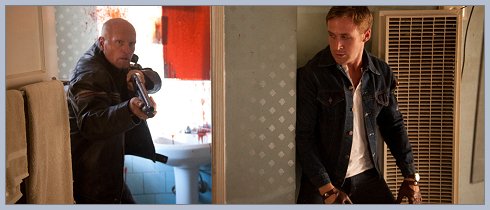
How do you feel about all the praise and Oscar buzz your performance in this film has garnered?
[laughs] You know, what's difficult about praise is that when you get into this [business], most people tell you that it's not possible or that you can't do it. Nobody believes in you when you're starting out, but for a few people...So you train yourself and numb yourself to other people's opinions, not because you value your own so much or you think they're better than anyone else, but because if you really listened to other people, you wouldn't do anything--you'd be too afraid to try it. And then suddenly, people decide that they like what you're doing and then they want to praise you, and suddenly, you're supposed to start caring again. But if you do, you're still taking the same risk. And in some way, if you start caring about what they think, it cheapens your relationship to the people who did believe in you when nobody else did.
What kind of music are you into these days?
Well, I love the music in this film. I'm really excited. I think it's exciting to have a good soundtrack. You know, I used to love to buy soundtracks, and I kind of stopped a while ago. But I think a lot of really great bands are on here: Kavinsky and Johnny Jewel--he has Glass Candy and Chromatics...This whole dark disco thing that they're doing...I'm really into it.
Any chance we'll hear your own music in one of your films?
That would be weird, don't you think? Kind of take you out of the movie. [laughs]
|





