|
MEDIA: How did you both feel about being, together, the emotional heart and compass of this story?
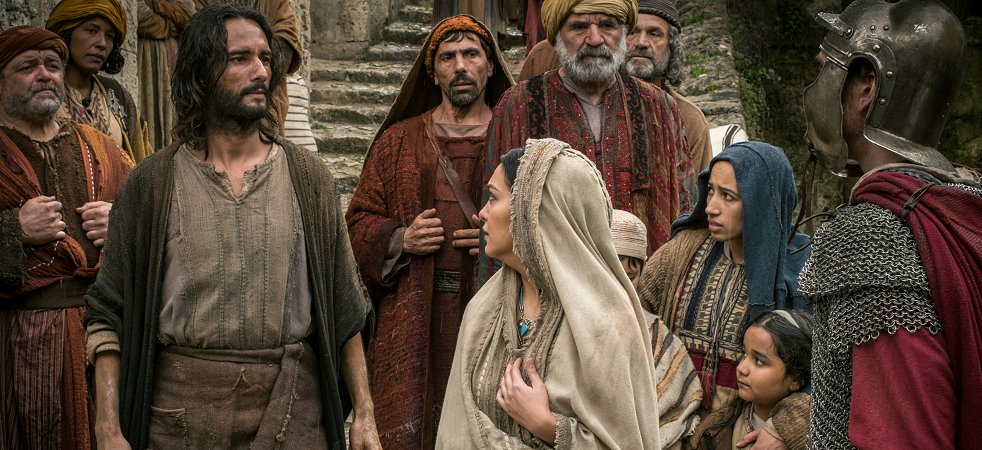
NAZANIN: Well, first of all, I think to be the emotional compass with this guy is quite a treat. We got to go to Mass and do our research together in Matera, and offscreen, we became friends. So I feel like their arc of pulling Judah through his journey--because Esther is inspired by Jesus and follows Jesus, and then pulls Judah through--for me became more profound because of offscreen friendships. When that happens, I think it's magical because they cast two actors [who] had never met before. And when you're able to cast two people who have that connection offscreen, it does translate, I think, on the big screen in the story.
RODRIGO: Absolutely. I agree with what she says...
NAZANIN: Thank goodness! [laughs] Can you imagine if you didn't? And I said all that and you were like, "Meh...I'm not so sure"?
RODRIGO: I mean, it's true. It's always important to have people around you when you're working, especially on location, that you get along with, that you feel for, and you actually, hopefully, will have a great collaborative experience. In this case, specifically because of these characters (I really don't like to refer to Jesus as a "character," even though it is), it was so important to me. It was just something that I can't even compare with anything else that I've done before. Because I had a personal relationship with it, more than ever, it was important to be connected to the heart, just like you said. Especially playing Jesus, it's about the heart, it is about love--you know, all his teachings are based on that, the unconditional love. So that's the place that I tried during the whole process to be connected to, my heart. And having Naz next to me, the person that I share my scenes, she and Jack...It was very important to have such a beautiful person--besides being a great actress, just having a person that will exchange with you and that will help to create this environment.
Was the scene of Jesus' crucifixion particularly harrowing to shoot?
RODRIGO: The crucifixion scene, for itself, it's very iconic--you know, the meaning of that defined society, we have before and after that moment. So it's needless to say, the weight and the responsibility that that moment [carried], and trying to re-create that moment, is quite a challenge. On that day, specifically when we shot, it was incredibly cold. There was wind, and it was very physically challenging. So it was very intense. It didn't last too long because we actually did it in one long take. They put us up there, we shot it, and then they took me out of it. But I don't know how long I was up there. It's hard to describe. I don't think the words would be fair to the sensation. Physically being like freezing, it was actually a good thing because it helped me to get out of my mind and to really come from a much deeper place than just thoughts and ideas. At the same time, I have flashes in my mind that I remember. I don't quite remember how it happened--because it was so cold, I couldn't think straight, basically.
Did you lose much weight for that scene?
RODRIGO: Yeah, through the whole thing. I dropped a lot of weight beforehand. As soon as I knew that I was going to do this part, which was like a month and a half, two months before, I went on a diet which I thought was appropriate. And it was hard because I was in Italy. There's a lot of pasta and gelato around. Trust me, it wasn't easy. [laughs] But very important. And I think also, to me, the diet wasn't about the physicality. It was about how it makes me feel. I think food is really important. What you eat will completely determine how you feel, how you think. So that was my goal with the diet. Besides having the right physicality for the part, I wanted to be in a much more subtle, profound place. And when you eat too much, when you're too heavy, your body's too busy trying to digest and trying to get rid of stuff that shouldn't be there, and so on...
NAZANIN: Plus, gluttony is a sin! So he was being sinless. He was getting into character. [laughs]
RODRIGO: Exactly. [laughs] No, it was purely with that purpose--just to try to be in that place.
Given how personal this experience was for you, and your obvious reverence, were you ever apprehensive, or even scared, to take this role?
RODRIGO: Very scared. Completely. Panicked! When the whole thing happened, it was overwhelming. It was like I didn't know what to think or what to feel, because first, I didn't expect [it]. It came out of the blue. [snaps fingers] And of course, I always had in the back of my mind, "Wow, it would be incredible one day if I could have the opportunity to play Jesus Christ." Just because aside from the fact that it's just the most iconic and important and meaningful and beautiful character, his story is so intense and it's so profound. So as an actor, yes, I thought about it, but I didn't see it coming. And when it arrived, it landed and I had all kinds of different feelings. And yes, I was scared. Throughout the whole process. The night before the crucifixion, how can you sleep? I mean, really? I'm like, "Okay, I'm not going to even try to force it. I'm just going to meditate here, I'm going to read and I'm going to chill." And many nights and many days. And fear is a big part of the whole process. But overcoming it is what we work for.
How did this particular opportunity come to you?
RODRIGO: Well, they sent me the script. I had a meeting over Skype with [director Timur Bekmambetov]. He was in Rome already. And I read the script and I had a meeting--like, he was on his phone with the writer, and I was in my home in Brazil, in Rio. And we talked about it, and I was very anxious. I just started to ask a lot of questions. The feeling was bigger than me. Basically, I didn't know what to say, what to do. In fact, I finished that call and my agent called me and said, "How did it go? Was it good?" I'm like, "I don't think so...I wasn't good, I was anxious." But actually, it didn't translate that way. They kind of liked that maybe because I was intense about it, there was something that made them feel they liked it right away. And the response was immediate. It's one of those things in life that as much as you prepare and you want to get it all right and perfect, when you don't, sometimes it's surprising how it can be.
Nazanin, your character Esther is such an inspirational force for Judah, even in such a male-driven movie. How did you approach the role, and how long did you work with Jack to develop your onscreen chemistry, which felt very believable?
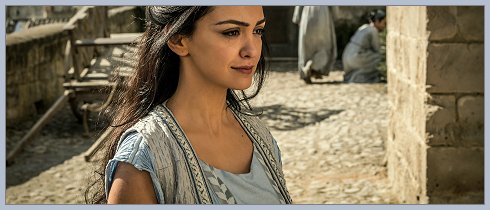
NAZANIN: Thank you, I appreciate that...We had a chemistry read. So I met him in November. And then January, we went over to Rome, and we had three weeks in Rome to sort of do rehearsals with Timur, and talk about scenes and run through scenes, and get to know one another. So that's how long we took. But honestly, I think it was right off the bat we seemed to have a good rapport. What I love about Esther is...You're right, I think especially in films like this, women are usually portrayed as demure and docile and voiceless. And I love that in this script, she had such a presence, and such a voice and such conviction. And she really does pull Judah through to Jesus. And I think that emotional arc of going from a woman who is questioning life and not certain and subservient to someone who stands up for herself, but does it with a lot of grace...She can confront the Messala character, someone who stripped her of the love of her life for five, six years, and killed her father, essentially torn her family apart. And yet she can go to him and confront him with forgiveness. I think in that moment, I realized the challenge of playing a woman of such strength. [laughs] And I aspire to be like her every day. She's going to always be inspirational to me, and I hope she has that effect on audiences.
Rodrigo, your portrayal of Jesus makes it a point to show him being a carpenter, which we don't see depicted very often in film and television. Were you actually building something in that scene?
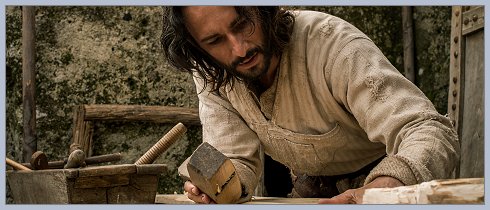
RODRIGO: Yeah, I was building a table. It was built, it exists. It's with my friend Rocco.
NAZANIN: [gasps] I didn't know that! I want it.
RODRIGO: It is with Rocco, the true carpenter that they hired. The thing is, the scene wasn't written like that. But the idea for Jesus in this film is to make him the most relatable possible--humanize, as much as possible, the figure of Jesus' presence. So for the first scene, it was written that he was there and they would meet. But I said, "Well, I should be really working. But I'm not going to pretend I'm working--I want to learn!" Well, in movies, you pretend a lot, you know? You can pretend, and it's fine. [But] to me, it was very meaningful and important to build. So they called a carpenter. His name is Rocco, he's from Matera. He is a carpenter, and he was my guardian angel throughout the whole story. Just a beautiful person that taught me. And I said, "What are we going to build?" Rocco says, "Well...Is movie, right? Doesn't matter." I'm like, "No, it matters. I want to build something." "A table!" I'm like, "Okay, let's build a table!" So we went through it days before, and the table is built, and he has it in his carpentry in Matera.
Nice! That is a great detail. Thank you both very much for your time today!
NAZANIN: Thank you, guys.
RODRIGO: You guys have a good day.
|