|
MIA WASIKOWSKA on 'ALICE IN WONDERLAND'
Contributed by Michael J. Lee, Executive Editor for RadioFree.com
February 20, 2010
In 2010's Alice in Wonderland, director Tim Burton re-imagines the mythology born of Lewis Carroll's stories about a young girl named Alice and her adventures in a fantastical world filled with an eccentric cast of characters. In this updated incarnation, Alice (Mia Wasikowska) returns to the fairy tale world of her childhood as a young woman, only to find that the Red Queen (Helena Bonham Carter) has usurped her sister the White Queen (Anne Hathaway) and subjugated all of Wonderland under her erratic rule. Lacking faith in herself and her own perception of reality, Alice teams up with old friends like the Mad Hatter (Johnny Depp) to regain her long lost self-confidence and free Wonderland from the Red Queen.
Alice in Wonderland utilizes a variety of techniques to present a signature visual experience. From obvious effects (the Red Queen's disproportionate head, Alice's ever-changing height) to subtle tweaks (the size of the Hatter's eyes, the length of the Knave's legs), the movie revels in creating a unique style with color, costuming, and perspective.
In this interview, newcomer Mia Wasikowska talks about stepping into the title role of this epic fantasy adventure.
MEDIA: How familiar were you with Lewis Carroll's stories about Alice, and what impact have they had on you?
MIA: I read the books when I was about 8 or 9, and then I read them again before we started filming, and as an older person, I saw a whole other side to them that I didn't really catch as a kid. And I think it's amazing--it kind of constantly reveals itself to you in different ways, and the humor becomes evident. And I'm sure as a kid, I saw something else that I didn't get as an adult--there were parts that I would have loved as a kid that I probably missed as an older person.
 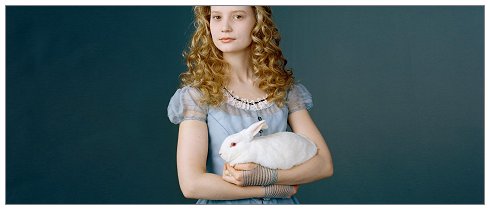
What aspects of Alice and her story particularly spoke to you?
I think that a lot of people experience something that she's going through at this time in the story: this discomfort in your skin and in who you are. And she just sort of has this awkwardness about her that I think a lot of people really go through in their life. And so that was something that I understood. And then, ultimately, her story is her coming back to who she is as a young girl, which is very assertive, very sure of what she believes is right and wrong. And so the story is her reconnecting with herself.
How was your experience of working with Tim Burton? It must have been exciting...
[laughs] Yeah, it's pretty cool. I mean, I've loved his films for such a long time. The coolest part was actually seeing [his work] from the beginning, because I always just see final products. So just to see the whole process was really amazing. And also, Tim's really trusting as a director, and from the minute that you're cast, you just feel a lot of trust and freedom, and [he's] very collaborative as well, which is sort of all you can ask for.
|





